Dive Brief:
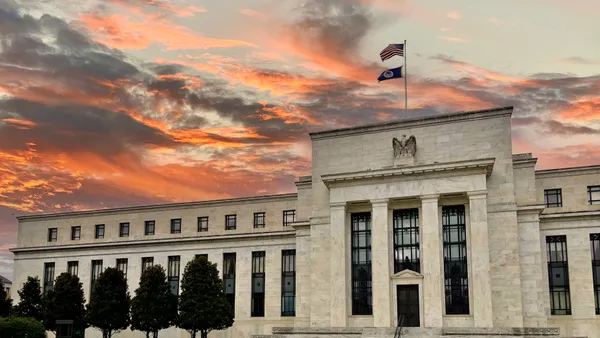
- The Federal Reserve on Wednesday, in a decision with three dissents, trimmed the main interest rate by a quarter point to a range between 3.5% and 3.75% as concerns about weakness in the job market overrode worries that inflation persists above the central bank’s 2% target.
- Fed officials in a median projection forecast just one quarter-point reduction in the federal funds rate in 2026. They expect that their preferred measure of inflation — the personal consumption expenditures price index less volatile food and energy prices — will end 2026 at 2.5%, 0.1 percentage point lower than their September estimate. They raised their forecast for economic growth next year to 2.3% from 1.8% in September. Central bank officials also estimate that the unemployment rate will end 2026 at 4.4%, no change from their September forecast.
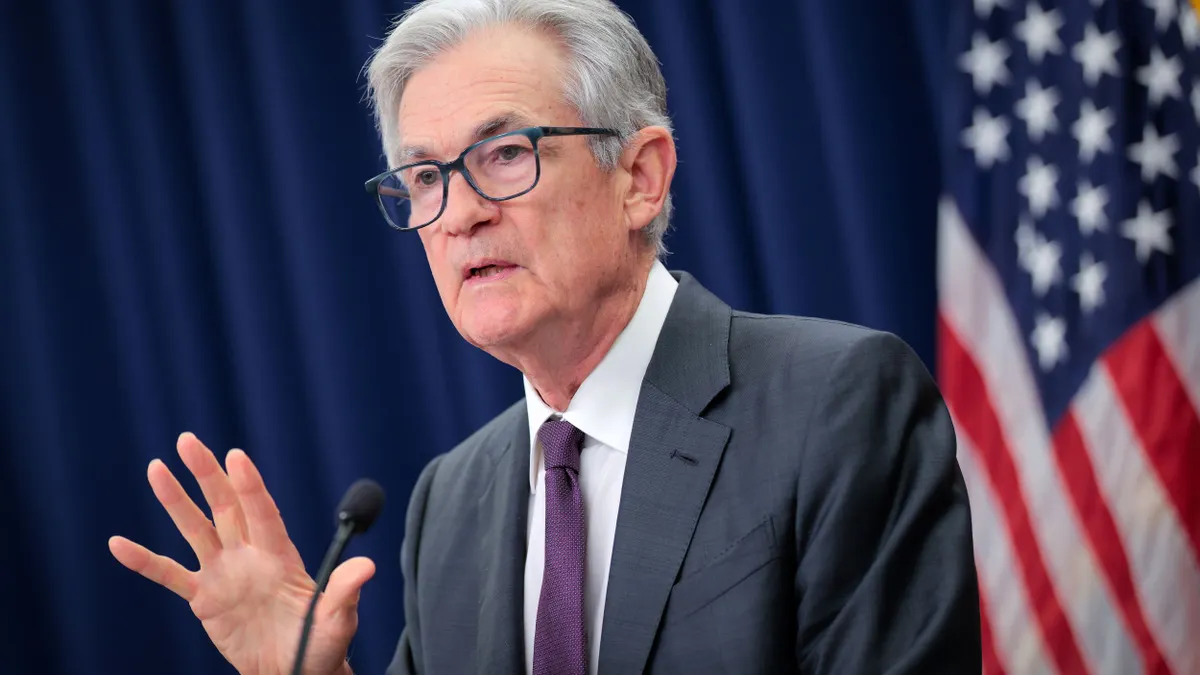
- In light of a “less than dynamic and somewhat softer labor market, the downside risks to employment appear to have risen in recent months,” Fed Chair Jerome Powell said during a post-meeting news conference.
Dive Insight:
Fed officials for months have tried to navigate the constraints of what they call “two-sided” risks, as stubborn inflation and a softening labor market imperil their efforts to ensure price stability and full employment in line with a congressional mandate.
By reducing borrowing costs, policymakers risk spurring inflation. By holding rates steady, they may fail to avert a surge in unemployment. The 43-day government shutdown denied them the timely data that bolster confidence in monetary policy decision-making.
“There is no risk-free path for policy as we navigate this tension between our employment and inflation goals,” Powell said.
Still, Powell emphasized that the bigger threat is to the job market. Unemployment rose 0.3 percentage points from June to September, average monthly payroll increases have turned to losses, and surveys of households and businesses show a decline in both the supply and demand of workers, he said.
“Job gains have slowed significantly since earlier in the year,” Powell said. “A good part of the slowing likely reflects a decline in the growth of the labor force due to lower immigration and labor force participation, though labor demand has clearly softened as well,” he said.
The jobless rate, at 4.4% in September, has inched up during the past several months. Hiring has also slumped across the economy. At the same time, inflation for months has held firm at around 3%.
Powell’s comments echoed the view of the Federal Open Market Committee.
“Job gains have slowed this year, and the unemployment rate has edged up through September,” the FOMC said in a statement after its two-day meeting, adding “downside risks to employment rose in recent months.”
Chicago Fed President Austan Goolsbee and Kansas City Fed President Jeffrey Schmid cast dissenting votes, saying they favored no rate change, while Fed Governor Stephen Miran dissented while calling for a half-point cut in the benchmark rate.
Despite the dissents, policymakers agree that they need to curb inflation to 2% and head off a downturn in the labor market, Powell said.
“Interestingly, everyone around the table at the FOMC agrees that inflation is too high and that we want it to come down, and agrees that the labor market has softened and that there's further risk,” Powell said.
“Where the difference is — how do you weigh those risks, and what does your forecast look like?” he said. Also, “where do you think the bigger risk is?” he said.
The highest tariffs since the 1930s have fueled inflation beyond 2%, Powell said, while noting that the price pressures from import taxes should wane after the first quarter of 2026.
“Goods inflation is entirely in sectors where there are tariffs,” he said.
By reducing the federal funds rate by 1.75 percentage points since September 2024, policymakers have cut borrowing costs to a level that, based on a range of estimates, neither slows nor spurs economic growth, Powell said.
“We are well positioned to wait and see how the economy evolves,” he said.
Editor’s note: This is an update to a previous story.