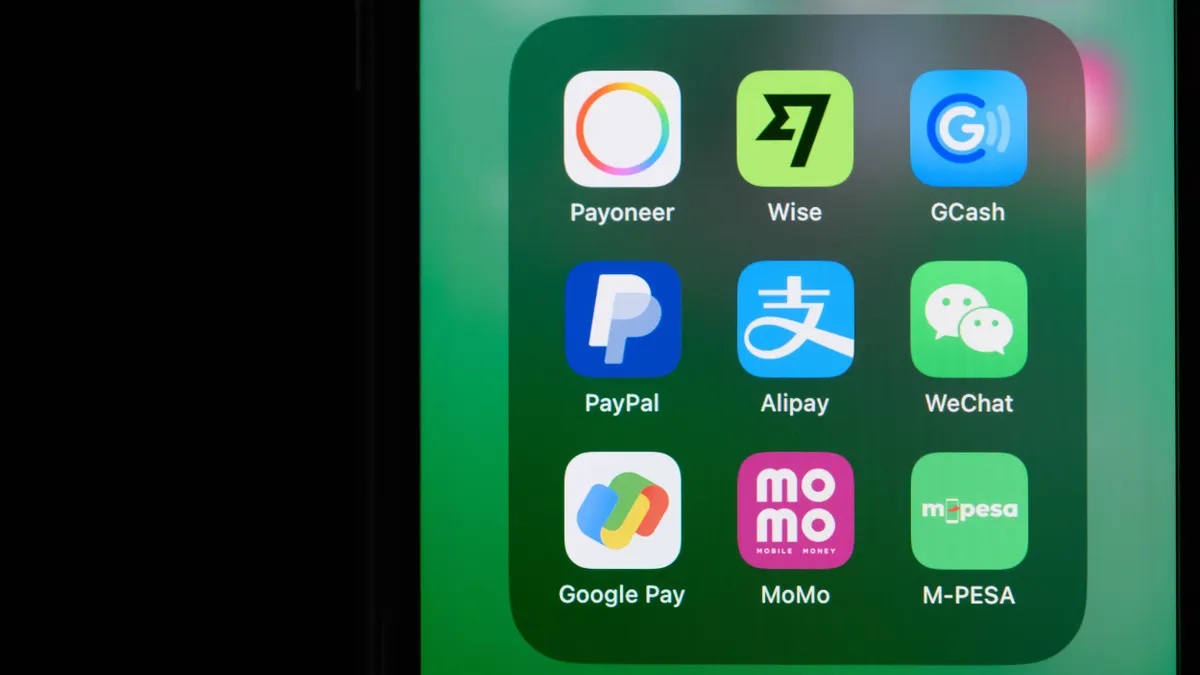
Businesses worldwide took steps to ensure they could remain stable in the face of large-scale regulatory, geopolitical and technological change over the past year. For New York-based Payoneer, a provider of money transfer and digital payment services, the shifts in global trade represent both “threat and opportunity,” CFO Bea Ordonez told CFO Dive.
“I think in times of volatility and dislocation, business owners look to diversify and derisk,” she said in an interview. As Payoneer looked to its role in that ecosystem, the focus was on “how can we support that ambition?” she said.
The simple approach
For many companies and their finance chiefs in 2025, the key word was “volatility,” as CFOs were tasked with navigating widespread shifts in everything from price pressures to the potential uses of new technologies like artificial intelligence. Global trade, however, proved to be somewhat resilient, despite a “tariff and macro environment that was very, ‘stop-start,’” over the past year, Ordonez said.
To navigate through that murkiness, Ordonez put Payoneer’s approach simply: “You have to focus on the things that you can control and look to adapt to the things that you cannot,” Ordonez said.
Ordonez has served as CFO for Payoneer since January 2023, according to her LinkedIn profile. Before Payoneer, she served as chief innovation officer for Webster Bank and has previously held CFO roles for Starling Bank and OTC Markets Group.
One of the company’s key differentiators is that it is “highly local” despite being a global business, a “North Star” that continues to inform its strategy into 2026, she said.
Payoneer’s global network spans across 7,000 “trade routes” comprised of partnerships with nearly 100 different banks and payment providers, and currently holds eight regulatory licenses to handle business payments across markets, according to a Dec. 29 shareholder presentation. It also recently announced it has received a license from the Reserve Bank of India to operate as a payment aggregator for cross-border payments within the region, according to a Jan. 22 press release.
As the financial services company begins the new year, its focus will be on continuing that local access on a global scale. That means both “ensuring that we're continuing to invest in our core ecosystem, in our tech stack and money movement capabilities…but also in innovation to continue unlock value for the next 20 years,” Ordonez said. Founded in 2005, the company celebrated two decades of operation last year.
Promising use cases
As it continues to expand its partnerships with key local and global players, including Chinese e-commerce giant Alibaba and fellow payments player Stripe, Payoneer is also eyeing new technologies. The company is “investing in a stablecoin enabled strategy that we think is super interesting,” Ordonez said. She previously told CFO Dive in a June interview that stablecoins were “complementary” to Payoneer’s business.
Digital assets which have their value pegged to another asset — typically a fiat currency, such as the U.S. dollar — stablecoins saw an uptick in attention from business leaders and payment players in 2025 as President Donald Trump’s administration took steps to bring those assets closer to the financial mainstream. That included legislation such as the GENIUS Act, which sketched out some requirements for stablecoin issuers but left some regulatory and risk gaps businesses are still navigating.
In August, Payoneer announced a partnership with Citibank which aims to utilize the bank’s blockchain technology to help move money across Payoneer-owned accounts, the first step in a long-term strategy “to deploy stablecoin capabilities and to integrate them into our treasury processes,” Ordonez said. Though the assets can offer key benefits for treasury and cross-border payments, “barriers to entry” still remain as the industry continues to seek regulatory clarity, she said.
Payoneer has also continued to keep its eye on AI, finding some “really promising use cases” for agentic AI within its support and relationship management teams, she said.
For herself, Ordonez has found generative AI to be useful in administrative areas: though “I can certainly tell when people are writing or responding to emails with generative AI and I don't know that I love it,” she said.
The company rolled out a performance appraisal tool which used large language models to help enhance or augment what employees wrote, an application Ordonez wasn’t a huge fan of, she said. However, such tasks are not where she sees generative AI’s potential being put to the best use.
“In terms of areas of risk monitoring, transaction monitoring, how you manage large and complex risk models, how you really look to automate flows and processes within how you move money cross borders, that's where I lean into [it],” she said. “I can get AI to rewrite my emails, I suppose, but everyone will be able to tell that I did. I don't know how helpful that is.”