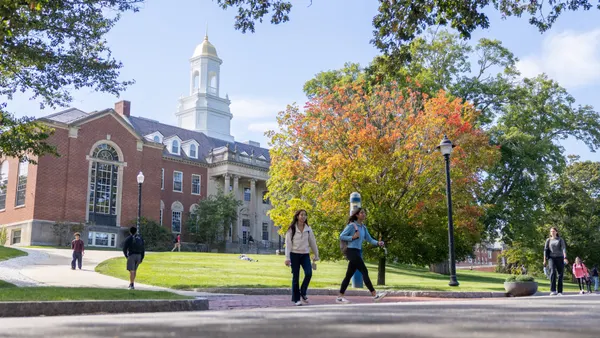
Incoming University of Connecticut CFO Anthony Rini and his 12-year-old son were among the many fans rooting for the school’s men’s basketball team to win it all in the final NCAA tournament game against University of Michigan Monday night.
The Huskies fell to Michigan 69-63 in what is reported to be the most-watched March Madness men’s tournament final since 2019. But Rini is proud of their accomplishments, believing the team’s run will deliver brand and enrollment boosts even without winning the tournament bragging rights.
“Losing to Michigan is not anything to be embarrassed about,” Rini told CFO Dive in an interview this week, noting that the score was very close. “I believe there will be an impact for enrollment next year even without winning because I believe people were watching the TV last night and the night before...and I think it gives UConn greater national presence. Some kid sitting in the Midwest will scratch his head and say, ‘let’s look at UConn.’”
Some schools have seen increased applications and donations follow victory in an athletic tournament. It’s known as the “Flutie effect,” named after Boston College quarterback Doug Flutie who secured a win in 1984 with a “Hail Mary” pass, increasing the college’s national exposure.
Rini will become UConn’s next CFO on April 27. He will join after holding a variety of roles over the past 14 years at Northeastern University in Boston, including most recently as chief operating officer.
In a wide-ranging interview earlier this week, Rini talked with CFO Dive about what sports means to him as well as his views on higher education and how he plans to approach his new role. This Q&A has been edited for brevity and clarity.
CFO Dive: What drew you to the University of Connecticut?
Anthony Rini: My mother went to college for 10 years at Hunter [College-CUNY], started in 1963 and finished in 1973 and had three kids in the middle. For me, I don’t technically consider myself first generation college because my mother went to college but I really was the first one in my family to go to college and go away. My parents were working class and they said you could go anywhere you want as long as it’s a public school in New York. That was the parameter so I went to SUNY Albany.
I’m just really really impressed with President Radenka Maric’s leadership. Her motto is students first. And that resonates with me. The other thing, there was something in the job description that really pulled me to the job which was this sentence which you never ever see in a CFO job description. And the sentence says that they want a collaborative leader who recognizes the role of the CFO as supporting and enabling the academic goals and educational and research missions. So that spoke to me because the majority of my career in higher ed has been on the academic side…so I always had an academic mindset. I understood that there’s more to higher ed than basic accounting of profit and loss. So that attracted me that they were looking for someone that is a strategist who really wasn’t a traditionalist.
CFO Dive: UConn’s president said in announcing your appointment that you’ll collaborate to explore funding sources. In general higher education’s business model has been disrupted by funding cuts. How do you anticipate navigating that and finding a new business model?
Anthony Rini: Connecticut has been incredibly generous to Uconn. But in general public education has had declining public support. That means tuition dollars have made up some of that gap and also private philanthropy and industry partners. The reality is that with tuition the price point is the price point. UConn has a peer set...and so you have to be competitive in that marketplace. You can’t just increase the tuition to close out your budget shortfall because you have to be competitive, you want the best students and you’re competing against the peer group.
The other part of that is discounting. Not everyone pays the full price of tuition so you’ve got to manage your discounting and you also have to look at the peer group around discounting. So really what we’re thinking about is the pie and how do we make the pie bigger, in the sense that, how do we grow revenue?
CFO Dive: As a CFO, how do you think about school sports?
Anthony Rini: Obviously Division I costs a lot but when you talk to enrollment management people having D1 sports is a real draw for enrollment both for student athletes who wouldn’t come there if they couldn’t play Division 1 and also for students who are just energized by athletics. I think in general [sports] plays a key piece in student recruitment and retention and so I think that’s an important piece of the puzzle and a differentiator at UConn. Alumni affinity for a place like UConn is significantly driven by sports. So for the CFO I think it’s a matter of looking at the whole puzzle and looking at each of the pieces and understanding how important athletics is to student recruitment and retention and how important it is to put UConn on the map nationally and internationally.
CFO Dive: What are your priorities for your first year at UConn?
Anthony Rini: What’s going to be fun is getting to know people and moving to UConn. I think working closely with the management, deans, provost and faculty and the president around enrollment strategy and making sure we’re financially strong and making sure we’re producing graduates for the jobs of the future...are all pieces of the puzzle.
CFO Dive: With all the challenges, are you optimistic about higher education’s future?
Anthony Rini: I’m very optimistic. The American public has lost trust in higher education. People want to understand there’s return on investment and if they send their kid to school they’re going to get a job and that job is going to be meaningful. When you think about the tuition at public institutions versus private I think public institutions really demonstrate their return on investment and really demonstrate their impact on the communities that they exist in. I’m very optimistic that all of higher education is going to get leaner and smarter about what they do and that’s going to turn the public trust around.