Dive Brief:
- Consumer sentiment rose 9% this month after a four-month slump as the average price of gasoline declined from highs it reached earlier in the war with Iran, the University of Michigan said Friday, reporting on survey results.
- The sentiment among consumers brightened from a record low regardless of age, education level or political affiliation, Joanne Hsu, the university’s director of consumer surveys, said in a statement. Expectations for personal finances and business conditions also improved, with lower-income consumers voicing the biggest upturn in mood, she said.
- “Even with June’s early gains, however, views of the economy are still relatively dour,” Hsu said, noting that sentiment is 13% below the pre-war level in January and 19% below a year ago. Households “feel burdened by the recent escalation in inflation and worry that higher inflation could remain stubborn going forward, particularly in the short run,” she said.
Dive Insight:
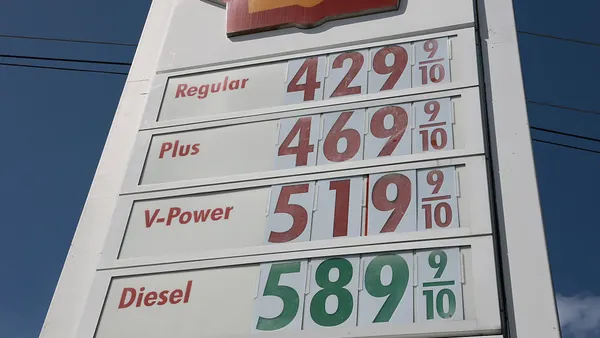
The price of crude oil has fallen during a ragged cease fire with Iran, prompting a decline in the average price of a gallon of regular gasoline to $4.11 from $4.50 a month ago, according to AAA.
In a signal that inflation may spread well beyond the cost of energy, wholesale prices rose 1.1% in May and 6.5% during the past 12 months – the biggest increase in four years, the Labor Department said Thursday.
Also, consumer prices jumped 4.2% last month — the highest level in three years — as a near-total blockade of oil shipments through the Strait of Hormuz pushed up energy prices, according to data released by the Bureau of Labor Statistics on Wednesday.
Rising energy prices generated more than 60% of the inflationary pressure last month, the BLS said. The so-called core consumer price index, excluding energy and food prices, increased in May by 0.2% and 2.9% on an annual basis, still well above the Federal Reserve’s 2% target.
Consumers see a direct link between the war and price pressures, Hsu said.
“As soon as the Iran conflict began, consumers really downgraded their views of the economy,” she said in a Bloomberg Television interview.
Referring to limited shipping through the strait, Hsu said, “if these supply disruptions remain in place with no end in sight, it's very likely that consumer views will remain sour.”
Consumers’ view of inflation improved this month but remain gloomier than before the war, Hsu said. They expect 4.6% inflation during the coming year, slightly less than their prediction last month, she said, citing interviews with consumers from May 19 through June 8.
Prior to the beginning of the war on Feb. 28, consumers forecast 3.4% inflation for the next 12 months, Hsu said.
Consumers are “still seeing a lot of risks on the horizon so overall, consumers still aren't feeling great, despite this recent pickup,” she said.