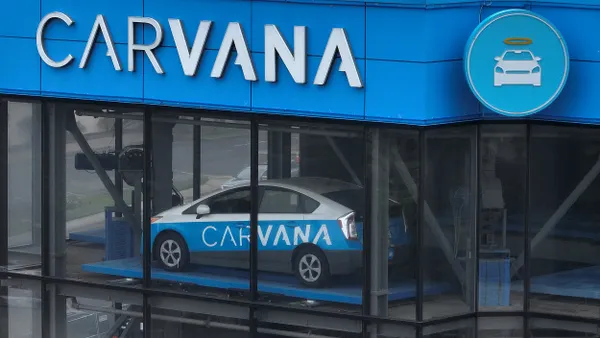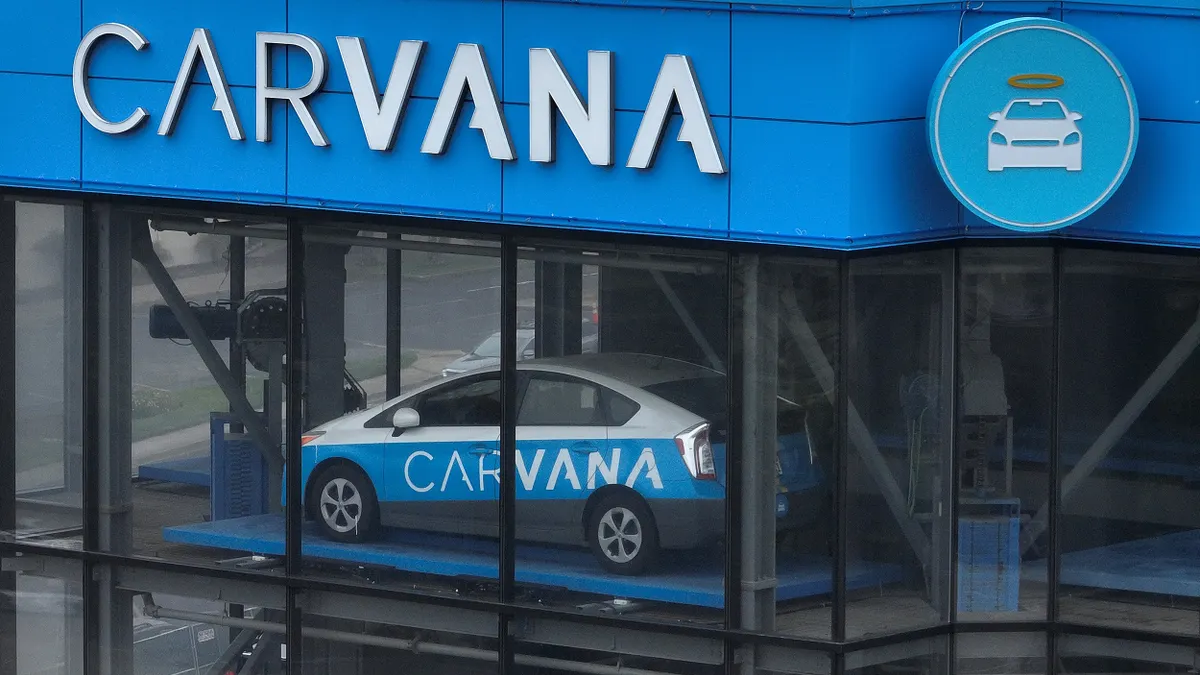
Carvana discloses all of its related party transactions inside of its financial statements, CFO Mark Jenkins said during the company’s earnings call Wednesday, refuting allegations by short sellers that the used car marketplace is not properly disclosing such transactions in its financial filings.
The finance chief’s comments mark the latest twist in a years-long debate that has swirled around the Phoenix, Ariz.-based company’s accounting practices, particularly surrounding its reporting processes regarding auto loans, according to a 2021 report by the Wall Street Journal.
Jenkins’ remarks on Wednesday came on the same day short seller Gotham City Research published a report alleging Carvana’s dependence on related-party transactions is “greater than disclosed.” The comments also followed a Jan. 28 report by the short seller alleging Carvana’s earnings were overstated by as much as $1 billion related to this dependence.
“We have checked every single detail of those short reports to ensure that all of our reporting is entirely accurate and definitively say that those reports are 100% inaccurate,” Jenkins said during the call according to a transcript on Seeking Alpha. “We don't sell loans to related parties. We disclose our related party transactions, and there's no ambiguity about that.”
Carvana CEO, President and Chairman Ernest Garcia III issued a “friendly request” to investors following Jenkins’ comments during the call, which were in response to analyst questions asking to clarify the related party transactions cited in the reports.
“If we have another short report during a quiet period at the end of the year, just maybe think back the last couple of years to recognize the pattern,” Garcia asked of investors.
At the heart of the debate swirling around the business is the familial relationship between Carvana’s founder and its largest shareholder, as well as the used car marketplaces they operate and whether those relationships have been properly disclosed in earnings reports and other Securities and Exchange Commission filings.
Carvana’s largest shareholder is Ernest Garcia II, who owns and runs Arizona-based car marketplace DriveTime according to a Forbes profile, with DriveTime also operating Bridgecrest Credit Company as its financing arm, according to The Wall Street Journal. His son, Ernest Garcia III, founded Carvana originally as a DriveTime subsidiary before spinning it off as its own company.
“We maintain a business relationship with DriveTime, a related party due to the Garcia Parties’ control and ownership of substantially all of the interests in DriveTime,” Carvana stated in its most recent 10-K filed with the SEC for its fiscal 2025. “We are party to a number of arrangements with DriveTime and its affiliates that cannot be assumed to have been negotiated at arm’s length.”
In its two reports, short seller Gotham City alleges that “Carvana, DriveTime, and/or Bridgecrest securitization SEC filings and disclosures to the SEC fundamentally mispresent and omit material activities between them.”
The Feb. 18 report cites a support page on Carvana’s website, which notes Bridgecrest as its third-party loan service provider, rather than a related-party. Gotham City’s research also details several cases it has identified where Bridgecrest, rather than Carvana, is the lienholder for loans and questions the mechanisms for such transfers — citing as evidence several responses by Carvana to consumer complaints filed with the Better Business Bureau where the used car marketplace identifies the financing provider as the lienholder.
Carvana did not immediately respond to requests asking to clarify the language on its support page.
Both the tangled relationship between Carvana and DriveTime, as well as its way of tackling loans, has long been the subject of scrutiny: in January 2025, now defunct short seller Hindenburg Research released its own report on Carvana, where it alleged $800 million in suspected loan sales to an “undisclosed related party.”
“Carvana appears to be dumping unreported costs of extended warranties onto related-party DriveTime, resulting in artificially inflated revenue and profitability,” a release on Hindenburg’s research reads.
Meanwhile, in 2021, Carvana’s auditor Grant Thornton flagged its practice of upfront loan sales as a critical audit matter — though not a misappropriation of rules, it was noted as particularly complex matter, according to the WSJ’s report at the time.
In its Feb. 18 report, Gotham City expressed concerns that the company’s auditors, presently Grant Thornton, will resign and “there will be an independent investigation into all these discrepancies.”
Shares of Carvana are down by approximately 16% year-to-date, according to data from Nasdaq, coming as the used car marketplace missed on EBITDA expectations but reported record revenue and net income for its full year. Net income increased by more than $1 billion from the prior year to reach $1.9 billion, according to its earnings report. Full-year revenue, meanwhile, rose 49% year-over-year to more than $20 billion.