For Royal Caribbean Group’s CFO Naftali Holtz, the cruise company’s commitment to delivering both stellar customer experiences and shareholder returns starts with a focus on providing its operating teams with the resources they need — and that “starts with investments,” he told CFO Dive.
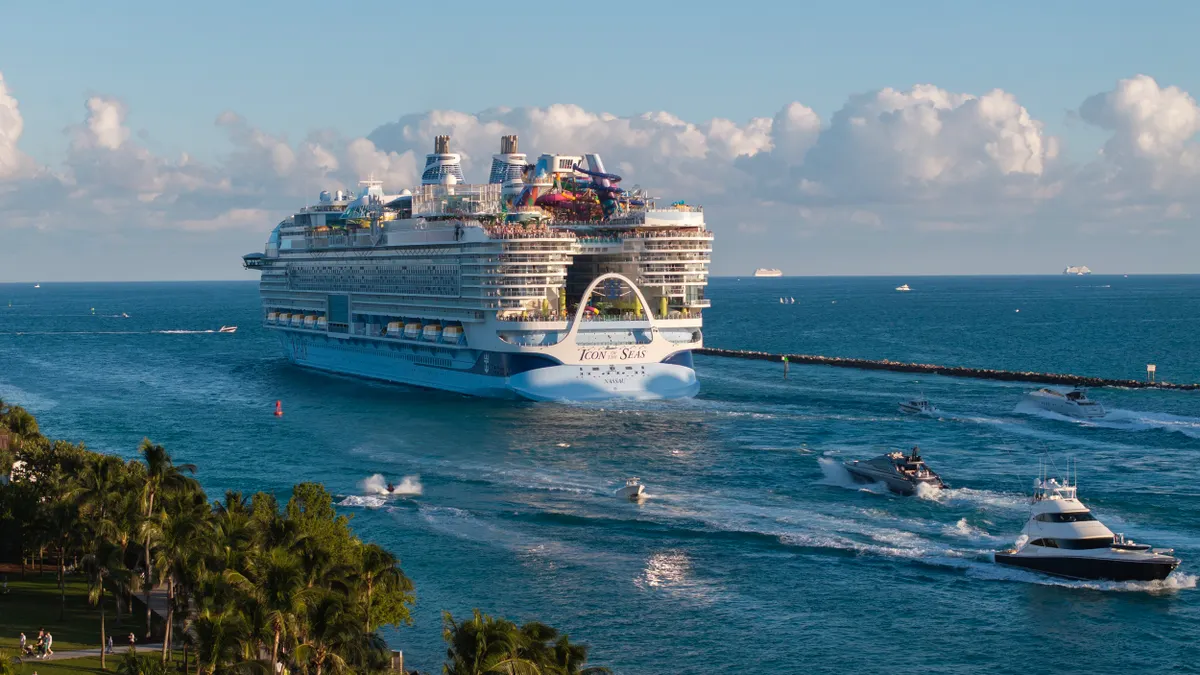
On Thursday, in tandem with results for its fourth quarter and full-year 2026, the Miami, Florida-based cruise and vacation company announced several longer-time commitments for the expansion of both its fleet and its vacation destinations, according to company releases. That includes an agreement with the Chantiers de l'Atlantique shipyard in France for the construction of two ships in RCL’s Discovery Class line — with the option for four additional ships — and a commitment from subsidiary Celebrity River Cruises to expand its fleet capacity from 10 to 20 ships by 2031.
“This will be a good focus for the next couple of years, making sure that we design the right experiences so we can get more people,” Holtz said in an interview Thursday following the comapny’s earnings call. In order to satisfy both cruise-goers and generate shareholder value, however, “we need to make sure that [we] know how much we pay for it. What are the opportunities to enhance revenue and margin of the new ships?”
Building resilience
For its full-year 2026, RCL is expecting capital expenditures to be around $5 billion — “predominantly related to the company’s new ship order book,” it said Thursday in its release for the quarter and full year ended Dec. 31. Non-new ship related capex is expected to hover around $1.8 billion, “a significant portion of which” includes previously announced private destinations under development, the company said.
As such, capital allocation has been “a great focus for us,” Holtz said, noting that, at the “same time that we have all these great growth opportunities, we're now at a scale and cash flow that we're also working on, how do we supplement that growth with capital return?”
In 2025, the company generated $6.5 billion in operating cash flow, and returned $2 billion to its shareholders via dividends and stock buybacks, according to an earnings transcript. As of Dec. 31, Royal Caribbean had a liquidity position of $7.2 billion, including cash and cash equivalents as well as undrawn revolving credit capacity, according to its Thursday earnings release.
Holtz joined Royal Caribbean Group in October 2019, just before the onset of the COVID-19 pandemic, as its senior vice president of finance, and stepped into the CFO role in January 2022, according to his LinkedIn profile. Prior to Royal Caribbean, he spent 12 years at Goldman Sachs in positions including managing director, head of lodging and leisure investment banking and VP, real estate, gaming and lodging investment banking.
The careful focus on capital allocation is part of an ongoing push by the cruise line operator to both improve customer experience and bolster revenue and profitability following the COVID-19 pandemic, which brought the broader cruise industry to a standstill — with RCL losing approximately $13 billion from 2020 to 2022, according to a Motley Fool report.
A surge in demand once travel restrictions were lifted, however, has helped the industry rightsize, with RCL paying down debt that accumulated through the pandemic and returning to profitability, according to the Motley Fool.
The younger generation, additionally, is leading the charge: since 2019, RCL’s total guest figure has increased by 45%, with millennial and younger generation guests nearly doubling, Holtz said. Combined with total revenues of $17.3 billion for 2025, a 64% jump, and a near doubling in net income to $4.3 billion, and “that tells you we build a more resilient, more profitable and a bigger company,” he said.
“We will be just shy of $8 billion of EBITDA this year, and that allows us to continue to invest in innovation,” he told CFO Dive.
AI personalization
Holtz expects customer demand to continue into 2026 and beyond, despite economic murkiness — RCL keeps a watch on how tariffs and other headwinds could potentially impact customers, for instance, and so far has not seen that impact.
The company is also tapping new technologies, including AI, to help further enhance the customer experience and further boost its financials, for example through onboard revenue. Investment in that area began before the pandemic, “and really the concept was, how can we give the customers their first day of the cruise back and reduce friction?” Holtz said.
Nearly half of 2025 onboard revenue was booked pre-cruise, the company said Thursday, and has approximately two-thirds of its 2026 capacity booked. Customers which do book such onboard experiences pre-cruise also tend to spend more than those that do not, he said.
AI could further help streamline such experiences, by helping RCL better understand and personalize those offerings. For example, if a cruise-goer comes with their kids and is looking to have a family vacation, “offering you a romantic dinner is probably not the right thing for you,” Holtz said. “Or if you just come with your significant other, offering you some kids activity or short excursion, it's probably not smart.”