More than two centuries ago the author of Frankenstein — Mary Shelley — wrote that “nothing is so painful to the human mind as a great and sudden change.”
A CFO entering 2026 while contemplating the severe changes of 2025 may understandably complain of at least a mild headache.
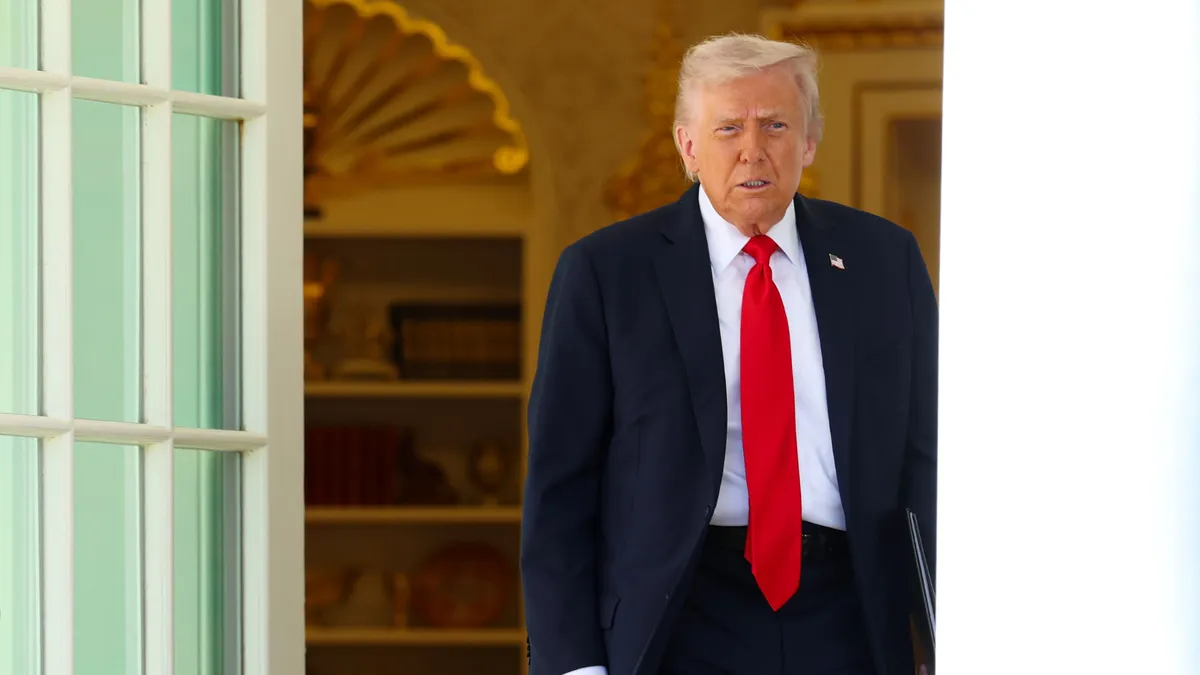
During less than a year in office, President Donald Trump has advanced some of the most jarring and momentous shifts in U.S. domestic and foreign policy in decades.
Financial executives will be better equipped to overcome challenges and seize opportunities when familiar with the following five Trump-induced changes shaping 2026:
1. ‘Strategic openings’ amid Trump disruption
The deportation of hundreds of thousands of immigrant workers triggered labor shortages in construction, agricultural and hospitality companies. The Department of Government Efficiency abruptly canceled billions of dollars in federal contracts with private companies. A freeze on clean energy electricity credits compelled companies to halt projects in wind, solar and electronic vehicles.
CFOs in 2026, as in 2025, should expect that the credo “move fast and break things” will persist as a salient feature of Trump administration policy, according to management consultants.
Trump is “a proponent of change and disruption, I think that’s clear,” Andrew Siciliano, global trade and customs services leader at KPMG, said in an interview.
“There's been continued disruption, uncertainty and evolving change in my world, so my clients are struggling through it,” he said. “We are constantly checking for updates.”
Trump’s seizure of Nicolás Maduro this month and the shift in U.S. national security strategy “to restore American preeminence in the Western Hemisphere” underscore the imperative for CFOs to ensure that scenario planning is timely, flexible and open to an unusually broad range of possible events, the consultants said.
Trump administration “policy moves quickly, and it targets industries with disproportionate economic ripple effects,” said Prashant Dubey, chief strategy officer at Agiloft, a contract management software company.
“While volatility creates obvious challenges, it also creates strategic openings for CFOs who can quantify exposure faster and more precisely than competitors,” Dubey said in an email reply to questions.
Amid the policy turbulence, CFOs need to keep investors well informed of any changes to business strategy, according to Kevin Zhao, senior engagement manager at Sapling Financial Consultants.
“CFOs should communicate proactively with investors about policy-driven strategy,” Zhao said in an email response to questions. “The goal is to position the firm as policy-resilient, not merely reactive.”
2. ‘Hard-hitting’ tariffs
Trump has proven especially disruptive in trade policy, flaunting across-the-board tariffs in April and sustaining the highest duties since the 1930s.
Import taxes would spur economic growth, reenergize manufacturing and bolster the middle class, Trump promised.
So far, only fiscal benefits are clear. Tariffs on the books in November 2025 would raise $2.7 trillion from 2026 until 2035, according to the Yale Budget Lab.
While a sizable gain over time, the tariff revenue is not enough to take a big chunk out of the $38 trillion total in U.S. debt.
The costs from import duties are high, according to economists.
Tariffs will push up consumer prices, especially for apparel, electrical equipment, computers and motor vehicles, according to the Yale Budget Lab.
The added costs will generate a $1,700 loss for the average household and slow economic growth by 0.5 percentage point. Also, unemployment will rise by 0.3 percentage point by the end of 2025 and 0.6 percentage point by the end of 2026.
At the same time, tariffs have fueled inflation less than anticipated — by about 1 percentage point — and may fade as a pressure on prices by mid-2026, Federal Reserve Chair Jerome Powell said last month.
CFOs will likely continue to confront a murky trade policy outlook, management consultants said.
Since the “Liberation Day” announcement in April, the White House has cut many of the import taxes, with differences varying across sector and sub-sectors, as shown by the import duties on steel and aluminum, Siciliano said. The changes make compliance with trade rules especially challenging, he said.
“The tariffs have been more expansive and hard hitting than we would have anticipated, so it’s forcing companies to pivot in many directions,” he said. “There’re tariffs stacking on other tariffs, evolving rules and interpretation.”
For example, the Supreme Court this month may decide that Trump overstepped his authority by imposing many of the import duties he announced in April, further scrambling the tariff outlook. Trump could set many of the same tariffs using different trade provisions, Siciliano said.
CFOs should hire a senior trade executive and deploy technology to track timely data and flows of goods across their supply chains, he said. At the same time, they should strengthen supply chains and ensure flexibility by diversifying suppliers geographically.
Finally, they should redouble efforts to ensure compliance with customs rules, he said, noting that U.S. Customs and Border Protection is hiring and training staff in its Trade Regulatory Audit division.
“One thing I can guarantee is that there’s going to be significant enforcement around these tariffs,” he said.
3. Fed: Lining up with Trump?
The Federal Reserve begins the new year falling short of its congressional mandate to ensure price stability and maximum employment. Inflation persists above the central bank’s 2% target and unemployment has inched up in recent months.
Policymakers in three meetings beginning in September focused more on safeguarding jobs than on slowing inflation, trimming the federal funds rate by a total of 0.75 percentage point.
Although Fed officials have not signaled more rate cuts, they will probably continue to prioritize the labor market for several months in 2026, attentive to its fragility from low hiring and a shrinking pool of foreign-born workers, according to Fed watchers.
Meanwhile, with the approach of the midterm elections in November, Trump will likely redouble pressure on the central bank to reduce borrowing costs and spur economic growth, the Fed watchers said.
So far Fed Chair Jerome Powell has resisted Trump’s call to cut rates to as low as 1% from a current range from 3.5% to 3.75%.
Yet Powell’s term as top policymaker expires in May, and his successor will likely fall in line with Trump, Aleksandar Tomic, director of the graduate programs in applied economics and applied analytics at Boston College, said in an interview.
“If that happens, then we will have larger than expected inflation, no doubt about that,” Tomic said. “I have a hard time seeing the new Fed chair not follow the president’s lead.”
Fed resolve to fight inflation would also likely flag if the surge of investment into companies focused on artificial intelligence proves to be a speculative bubble and bursts, Tomic said. “In that case, the Fed will need to charge in and pump in money, which will certainly be inflationary.”
4. Ending SEC ‘waywardness’
After his swearing in as chair of the Securities and Exchange Commission in April, Paul Atkins pledged to end the agency’s “waywardness.”
Speaking to President Donald Trump and others gathered in the Oval Office, Atkins said he would lead the SEC back to its core mission to protect investors, promote capital formation and ensure fair and efficient markets.
Based on the agency’s first several months under the Trump administration, restoring the originally intended role of the SEC will apparently mean smaller-scope enforcement.
During the fiscal year ending in September, the agency initiated just 313 stand-alone enforcement actions, a 10-year low, according to Covington & Burling.
Some of the plunge in enforcement stems from a 20% reduction in SEC staff last year and the administrative delay common during a presidential transition, according to Gerald Hodgkins, a partner at Covington & Burling.
The softer-touch also shows a shift in approach.
The Atkins SEC “is going to be particularly sensitive to the perception of a game of ‘Gotcha!’” Hodgkins said in an interview. “If the parties acted in good faith, but they got it wrong, there’s probably going to be an increased level of hesitancy in moving forward in those cases.”
In rulemaking, the SEC will probably narrow regulations on cybersecurity and executive compensation toward disclosure that aids decisions by investors, securities attorneys said.
On cryptocurrency, Atkins will likely prioritize averting fraud while dropping an effort by former SEC Chair Gary Gensler to regulate the digital assets as if they are securities, the attorneys said.
The SEC will also probably let fade the Gensler initiative requiring public companies to disclose performance metrics on environmental, social and governance goals, Hodgkins said.
Yet under Atkins, adherence to SEC regulations won’t necessarily be easier, the attorneys said.
“It’s going to be in some ways more complicated because there’s going to be a lot more changes,” Hodgkins said. “I don’t think that CFOs should think that there’s a holiday that’s coming.”
5. FASB faces pressure
After withstanding pressure from lawmakers last year to rescind income tax accounting rules, the Financial Accounting Standards Board in 2026 will probably face political heat again as it considers whether companies should account for stablecoins as cash or cash equivalents.
On paper, FASB is an independent standard-setter largely funded by accounting support fees paid by public companies. Yet there is pressure on FASB to set looser accounting standards for cryptocurrencies that would align it with Trump administration plans to soften regulation of digital assets, according to Jack Castonguay, an associate professor of accounting at Hofstra University in New York.
Under current standards underpinning Generally Accepted Accounting Principles, the master glossary defines cash equivalents as short-term “highly liquid” investments that are “readily convertible to cash.”
Such assets feature original maturity terms of three months or less and present “insignificant risk of changes in value” from shifts in interest rates, according to a FASB staff report citing three-month Treasury bills and money market funds among assets considered to be cash equivalents.
Standard setters are wrestling with how to account for different types of stablecoins. Some are pegged to the U.S. dollar and are especially liquid. But Castonguay said others can be backed by assets such as longer-term bonds and may have fallen in value to 85 cents on the dollar when they are needed to be converted to cash.
FASB may face arm-twisting by some lawmakers to treat stablecoins as cash equivalents, Castonguay said. Such a move would incorrectly signal to the market that stablecoins are as safe as cash, he said.
“I don’t necessarily think you will get pressure from Congress like we saw last year where they said, ‘We want to strip your funding,’” he said. “But I think I could see back channel pressure being a significant factor given the current administration.”
“It’s a new paradigm where politicians are more directly inserting themselves into accounting regulation setting,” he said in an interview.
Editor’s note: Maura Webber Sadovi contributed to this report.