When Bas Lustenhouwer applied for a finance chief role at a startup early in his career, he was told he lacked one critical qualification: CFO experience.
It was a Catch-22 for a young investment banker with his sights set on the CFO seat. Rather than wait for the right opportunity to appear, Lustenhouwer took an unconventional route — offering to work as a CFO for startups for free to gain the experience he didn’t yet have on paper.
That decision would define the next phase of his professional journey, taking him from investment banking in Europe into early-stage startups, and ultimately into the CFO role at Dexory, an AI robotics company now scaling across global markets.
This stage in his career comes as finance leaders face a more demanding operating environment. Economic uncertainty, shifting trade policies, evolving regulations, and rapid advances in AI are forcing companies to make decisions faster and with greater financial consequence.
It’s familiar terrain for a CFO who has built his career around taking on new risks and challenges.
Breaking into startup finance
Lustenhouwer began his career at Kempen & Co., a Netherlands-based financial services firm, where he worked across corporate finance and equity capital markets, before joining Tokyo-headquartered Nomura as an investment banking associate.
After spending three years at Nomura, he took a sabbatical for several months backpacking through South America. When he returned to Europe, he began exploring startup opportunities.
“I had a few friends building businesses, and hearing the war stories got me really excited,” he said.
He applied for a CFO role at a Dutch fitness startup but was told he lacked direct CFO experience.
“So I thought, okay, there’s a chicken-and-egg situation here,” he said. “How do I solve this?”
His answer was unconventional: he offered to work with startups for free as an interim CFO to build hands-on experience. He supported three early-stage companies in that capacity.
One of them, a business-to-business diamond marketplace called Nivoda, became his entry point into full-time startup leadership. After helping the company through its seed round, he was asked to join as CFO.
Lustenhouwer spent over six years at Nivoda, helping scale the company from early stage through multiple funding rounds and ultimately raising more than $100 million in total capital. By the time he left, he said the business had grown to more than 500 employees worldwide, serving roughly 10,000 jewelers across more than 65 countries.
But the role extended far beyond finance. He often worked across operations, logistics, and customer execution.
In one example from his time at Nivoda, he recalled delivering diamonds by bicycle in the Netherlands during a severe storm when logistics providers were unable to operate.
“The fact that FedEx wasn’t available wasn’t an excuse for a customer not getting their stuff delivered,” he said.
The hands-on CFO
Lustenhouwer said his experience illustrates how the CFO role can quickly expand in early-stage companies. “You have to be willing to get your hands dirty,” he said.
After leaving Nivoda and taking time off following the birth of his first child, Lustenhouwer eventually returned to startups.
Through his investor network, he was introduced to Dexory, where he joined as CFO in December.
Dexory already had an established finance team but was entering a more complex phase of growth — expanding into new markets, managing larger funding rounds, and navigating more formal governance and compliance requirements.
His arrival at Dexory came about two months after it announced a $165 million Series C round aimed at helping the organization to accelerate AI-driven product development and strengthen its commercial teams while expanding internationally.
Lustenhouwer said Dexory’s decision to appoint its first CFO reflected a transition many growing companies face: as the business becomes more complex, founders often need a strategic partner to help navigate decisions around unit economics, pricing and long-term planning.
Building a lean finance function
One of his early priorities in the new role is keeping the finance organization lean while increasing capability.
Before his arrival, Dexory had several open finance roles. He reduced the hiring plan to a smaller number of key positions, prioritizing efficiency over headcount growth.
“I really believe in a leaner, meaner finance machine,” he said. “Especially with AI tools coming in nowadays, so much manual work can be automated.”
The same operator mindset that shaped Lustenhouwer’s startup career now carries into his role at Dexory, where he is helping scale a company in a rapidly evolving market.
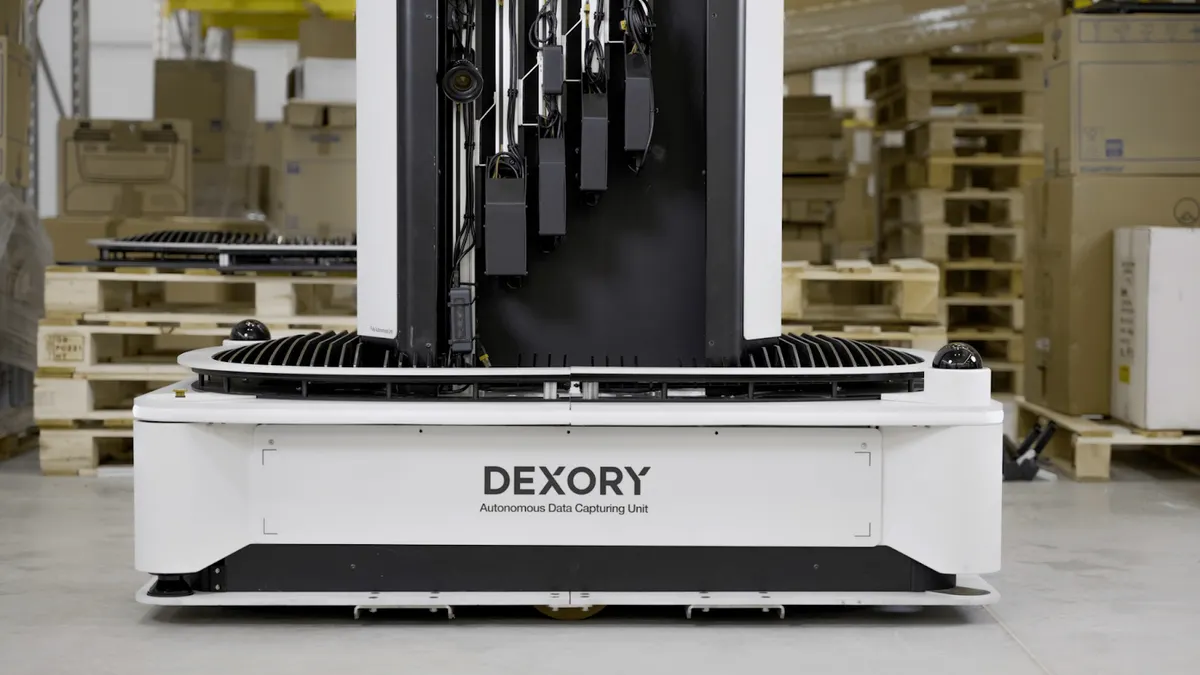
Dexory uses autonomous robotics to capture real-time data from warehouse environments and convert it into operational insights.
The market is being shaped by factors such as rising warehouse complexity, e-commerce growth and the need for greater supply chain visibility. Despite a weak overall macroeconomic backdrop, warehouse automation order intake rose by 7% in 2025, with multiple factors cushioning the market, according to technology research firm Interact Analysis.
“There's a lot of uncertainty at the moment, but that also creates an opportunity for us,” Lustenhouwer said.
“When supply chains are disrupted, having information about your inventory becomes even more important. That’s exactly where we play,” he said.