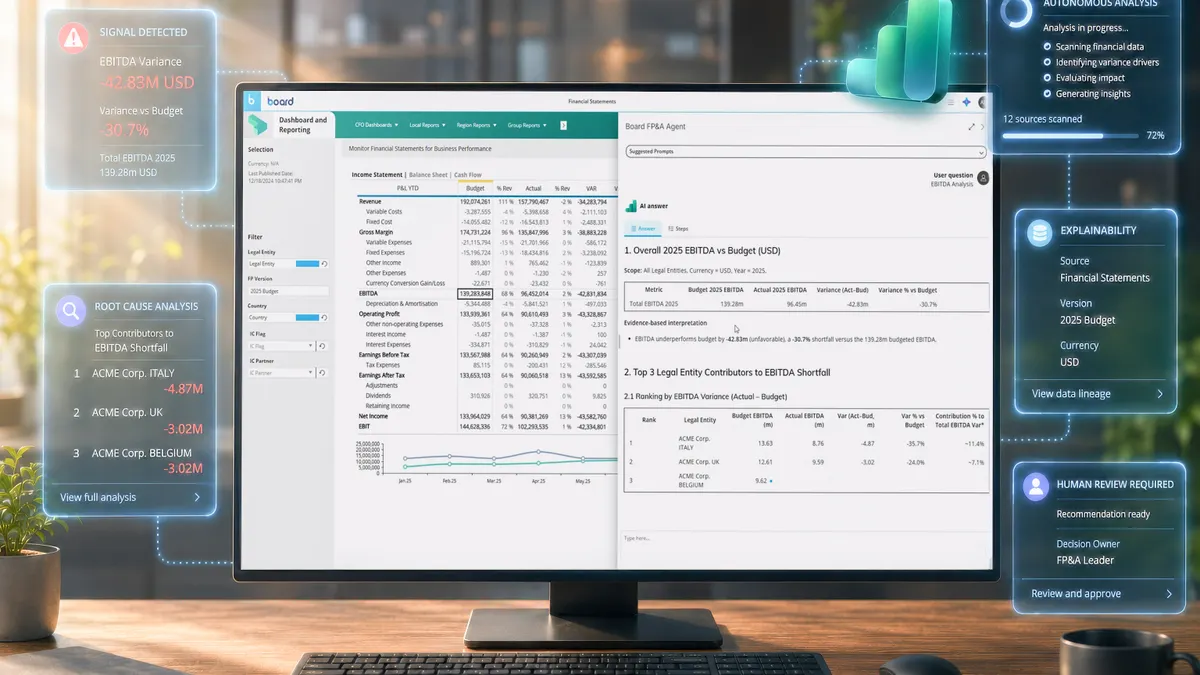

Artificial intelligence has recently crossed a key threshold in financial planning and analysis (FP&A). In the past, AI had been applied to automate and speed up the work finance teams already did. However, it can now initiate that work itself, detecting a change in conditions, launching the analysis, and surfacing a recommendation on its own—but, crucially, with human oversight remaining in the loop.
A recent report from Board dubs this change the Agency Shift, defining it as the transfer of FP&A initiation from people to advanced systems, while accountability, judgment, and decision ownership remain explicitly with humans.
The Agency Shift is taking place at a critical time for businesses, with macroeconomic and market challenges having left finance teams stretched thin at many companies. Board’s research found that high-value work, such as decision support and storytelling, comprises less than a third of overall FP&A time, while nearly half of capacity is consumed by manual data wrangling. Meanwhile, just 4% of organizations can refresh a forecast within a single day, a delay that creates a costly lag between a business signal and a management response.
Agentic AI offers the potential to solve these challenges, optimizing FP&A in an efficient, scalable way. However, organizations considering deploying these advanced capabilities must establish a robust governance structure that’s designed specifically for AI that doesn't simply carry out instructions, but actually makes decisions.
What the agency shift actually means
The previous generation of AI-assisted FP&A featured tools that could complete tedious, time-consuming, relatively simple processes assigned by humans so finance professionals could spend their time elsewhere. Agentic AI is fundamentally different.
Where earlier tools waited for an analyst to initiate the process, agentic systems continuously scan for signals and launch the analysis the moment conditions warrant it—whether an eroding margin, a demand swing, or a coming cash gap—rather than waiting for the next reporting cycle.
“It's now not only about automation,” says Simone Ferrari, Product Manager – FP&A Solutions at Board. “The real power is in shortening the gap from facts to decision by compressing the distance between an event and a finance leader's response.”
The payoff is not only speed but foresight. By monitoring continuously, these systems can surface emerging problems that teams previously had no practical way to catch, enabling finance teams to respond to a signal before it’s too late.
But the same autonomy that closes the timing gap can also widen the potential for risk. The more leeway an AI system has to act on its own, the greater the potential efficiency gains, but exposure also increases along with autonomy. That’s why human oversight is critical.
“AI should be used to support human judgment, not replace it,” Ferrari says. “Humans should be behind the steering wheel.”
Where governance can break down
Governance is often treated as the territory of corporate IT or legal departments. But when an AI agent is responsible for shaping a forecast or reallocating a budget, the accountability falls on financial leadership.
To meet this responsibility, finance leaders must shift their mindset to one of what Board calls “architected accountability.” This means the finance department defines the rules, thresholds, and boundaries within which systems are allowed to operate, and is prepared to own outcomes that were not manually produced.
Developing and establishing those guidelines often acts as a diagnostic function, revealing governance weaknesses that may have long been in place, but weren’t previously so obvious.
“Agentic AI exposes the governance debt that was already there,” Ferrari notes. The first cracks to appear can include semantic inconsistency, where different systems code the same thing in different ways; approval workflows too loosely defined to give an agent clear thresholds; and auditability gaps, when no one can trace where a certain number came from, he adds.
The common thread behind those weak points is a lack of explainability; the ability to see, and to show, exactly how a system reached its conclusion. That explainability is key for leaders who must defend AI-assisted decisions to auditors, boards, or regulators.
“The AI did it; I don't know why is not a good enough answer,” Ferrari notes. “Leaders need to know what data was used, which version or scenario it drew from, which drivers shaped the output, and which thresholds applied.”
This explainability—and the visibility that enables it—is built into Board’s platform, Ferrari notes.
“Our agents are built to be transparent. For every prompt, users can see the exact data sources, the data selected, the company, even the currency,” says Ferrari. “Explainability is engineered in, not added on afterwards.”
Getting started
For companies that want to leverage the power of agency shift, Ferrari recommends a phased adoption path, starting with the use cases that generate the most value so AI can amplify the return on the highest-impact work.
“Begin where AI can make the biggest difference, measure the value it creates, then learn, adjust, and expand,” Ferrari advises. “This way, each new use case builds on the confidence and the controls you've already proven.”
Under this approach, each successful deployment strengthens the governance foundation and paves the way to the next. With capability and governance advancing together in this way, organizations are well-positioned to capture the full potential of agentic AI to transform their FP&A operations.
Contact Board to learn more about building the infrastructure to support the FP&A agency shift.