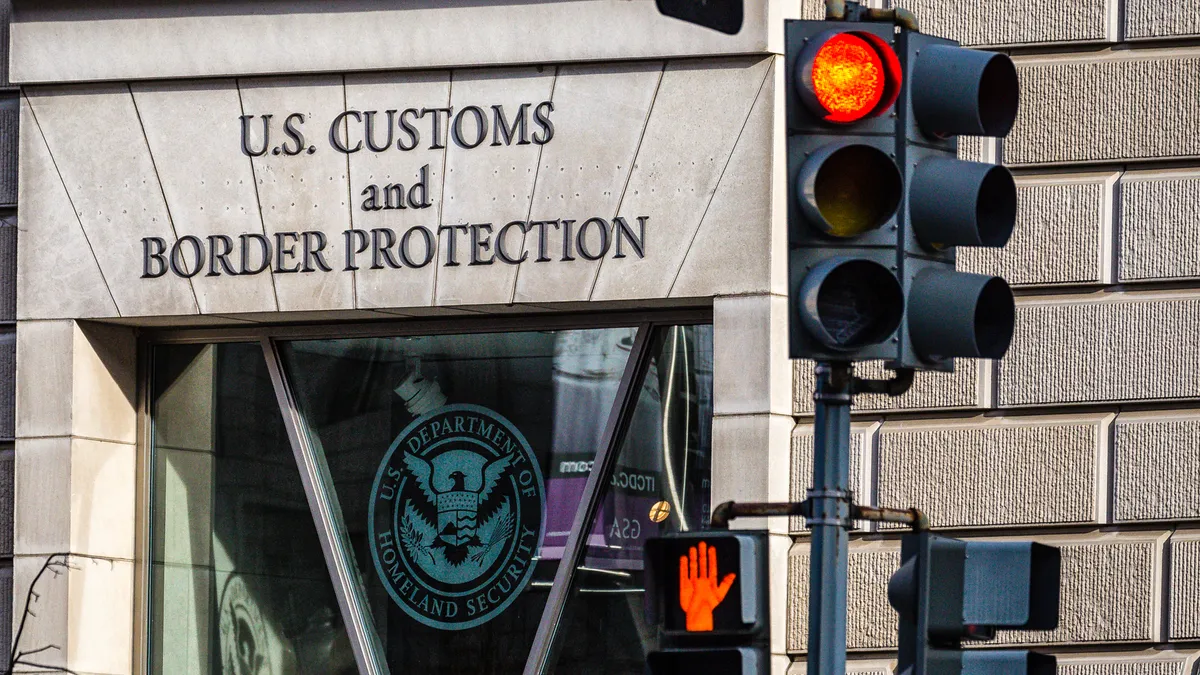
The federal government’s tariff refund process is exceeding many industry observers’ early expectations, even as CFOs confront tricky questions around payments now flowing through the system.
Early fears that U.S. Customs and Border Protection’s tariff refund portal would buckle under volume or become bogged down in documentation requirements have largely not materialized, accounting, tax and customs advisers told CFO Dive.
Instead, attention is shifting from early operational concerns to questions about how companies will account for and manage payments. This comes as the government says it has already processed billions of dollars in claims.
“Companies are now seeing refund requests progress from submission to acceptance and, in many cases, into Treasury for payment processing,” said Lynlee Brown, a partner in the global trade practice at Ernst & Young.
Brown said EY has visibility into more than $500 million in refund claims filed. A handful of those companies have started to receive refunds as of May 12, she said.
Joshua Chananie, a partner at accounting, tax and advisory firm Sax, said his own outlook on the process has shifted sharply in recent weeks as claims and payments accelerated faster than many advisers anticipated.
“I wouldn’t even say surprised — shocked,” he said, describing his reaction to the process so far. “I was not very optimistic in the beginning that there would be any money coming back.”
Rapid process
CBP launched an online portal on April 20 to accept claims from businesses for refunds tied to tariffs that were struck down by the U.S. Supreme Court in February.
As of May 22, CBP has accepted roughly $85 billion in potential and certified tariff refunds for processing through the system, with about $20.6 billion already approved and sent to the Treasury Department for disbursement, the agency said in a May 26 court filing.
Chananie said refunds are not flowing exclusively to large multinational companies. “Even small companies are starting to receive refunds,” he said.
A key hurdle in the refund process is getting data entry right when submitting claims through the portal, according to Charles Clevenger, a principal at audit and tax consulting firm UHY. While the process is generally functioning as intended, many early wrinkles stem from data inconsistencies within company submissions rather than systemic failures, he said.
“Where there has been maybe a rejection, it's been really around the data itself and getting it right so that the records for the refund request match with the original tariff records,” Clevenger said. “As long as those things match and companies are following the prescribed process, we're not seeing any issues.”
While the process for submitting claims has been relatively straightforward, requiring little more than basic entry data, having detailed documentation remains critical in the event questions arise in the future, warned James Robinson, a principal at accounting and consulting firm Armanino.
“You weren’t required to file additional documentation with the claim, but you may need it to at least back up what you put into the system,” he said.
Accounting, tax questions emerge
Meanwhile, as refunds begin flowing, a more complex set of issues is emerging.
Recent disclosures in earnings calls have raised questions about whether companies should recognize claimed — but not yet received — tariff refunds for accounting purposes.
Ford Motor Co. recorded a $1.3 billion “benefit” in the first quarter tied to potential tariff refunds, CFO Sherry House said in a late April earnings call. That disclosure came a day after competitor General Motors announced that it was raising its full-year 2026 guidance on the expectation of about $500 million in tariff refunds.
“To the extent that you have some certainty about the amounts and what you're getting, there is no preclusion from recording them,” said Ali Baydoun, a partner at UHY. “It's about getting to that level of comfort where you've done enough to feel very certain about those amounts, and you're not kind of jumping the gun.”
Premature booking of anticipated refunds may come with risks, Baydoun warned. “You don't want to over-promise and under-deliver,” he said.
Tax considerations add another layer of complexity for companies receiving refunds. Most refund recipients will likely face a tax liability, although the exact treatment can vary, with complex questions arising in some cases depending on how the company originally recorded tariff costs, according to advisers.
“If your business treated those tariffs as a deductible expense, then getting that money back can change things,” according to an advisory paper published by Prado Tax Services, an income tax preparation firm in San Leandro, California. “The refund may need to be reported as income, which increases your taxable amount for that year.”
Lawsuits pile up
Legal risks are also emerging alongside tax and accounting questions, as tariff refunds face increasing scrutiny in the courts.
A growing wave of litigation is already testing whether importers that receive government refunds can legally keep money that downstream customers say they effectively paid in the first place.
Lawsuits against companies including FedEx, UPS, Costco and Lululemon allege they improperly retained tariff-related reimbursements after passing tariff costs through to customers.
“Litigation against importers is already underway, driven by the theory that customers — not importers — were the real economic victims of the tariffs, and are therefore entitled to at least a share of any refunds,” according to a report by New York-based law firm Carter Ledyard & Milburn.
Plaintiffs have asserted claims such as unjust enrichment and consumer protection violations. Some companies have indicated they intend to pass reimbursements back to customers while others have not publicly addressed the issue, the report noted.
Anders Lillevik, CEO and founder of procurement software firm Focal Point, said teams are increasingly being forced to reconstruct how tariff-related costs flowed through supplier contracts, renewals and customer pricing decisions during the tariff period.
“It's a bit of a mess,” said Lillevik, a former chief procurement officer at Fannie Mae. The challenge may be particularly acute for companies that lack the infrastructure and staffing to manage such a process, he said.
Advisers said CFOs are key players in helping organizations navigate emerging tariff refund questions, although they need to partner with other stakeholders such as tax, legal, procurement and supply chain leaders.
“This is most definitely a CFO issue,” Brown said. “They don’t have to be in the weeds, but they do need to” be closely involved.
Editor’s note: This story was updated to include information from CBP’s May 26 court filing on the status of tariff refund processing.