Dive Brief:
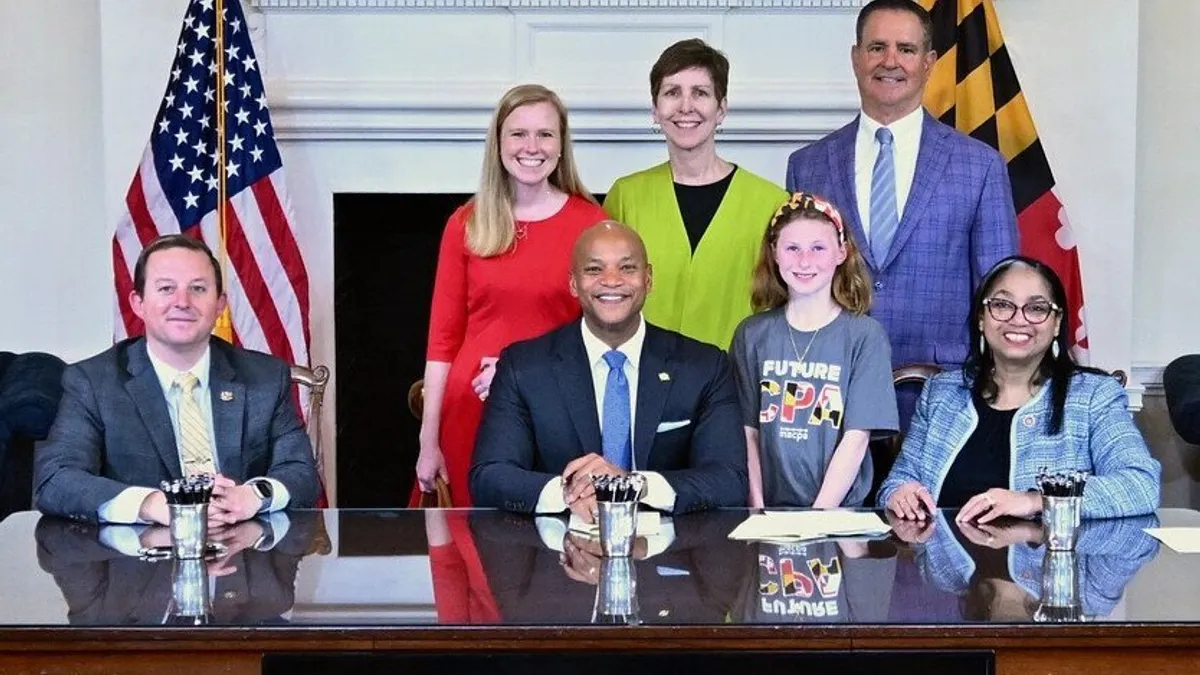
- Maryland Gov. Wes Moore signed the state’s Certified Public Accountant licensing reform bill (HB643) into law on Tuesday, according to a spokesperson for the governor’s office. Maryland is one of about 39 states that have enacted laws easing licensure requirements, according to the National Association of State Boards of Accountancy.
- The new law effectively lowers a long-controversial barrier into the profession by adding an alternative third path to becoming a CPA that doesn’t require 150 hours of college credit, which is typically five years of post-secondary education.
- Under the new rules that are effective Oct. 1, CPA candidates in the state will be able to substitute more experience for the extra schooling, with the new path requiring aspiring CPAs to pass the CPA exam and complete a bachelor’s degree along with two years of professional experience.
Dive Insight:
The initiative, aimed at reversing a decline in students pursuing accounting, has drawn some criticism from those who believe the traditional path better prepares candidates for both the exam and the profession’s rigors. Meanwhile, some industry players initially feared it would create a licensing patchwork that would harm the ability of CPAs to work across state lines.
Yet over time the industry consensus has shifted and, since early last year, a nationwide groundswell of support has backed the licensing changes. In Maryland, the legislation, co-sponsored by Del. William Wivell, a CPA, drew strong support from the state accounting association.
“This milestone is the result of a profession, local, national, and global, coming together, debating, listening, and ultimately uniting around a path forward to create more opportunities for the next generation,” Rebekah Olson, CEO of the Maryland Association of CPAs, wrote in a Wednesday LinkedIn post.
Jack Castonguay, an associate professor of accounting at Hofstra University in New York, applauded Maryland’s move to make the change. “They’ve got the hard part out of the way,” he said in an interview, noting that the CPA pathways nation-wide push is well past the “tipping point.”
However, he said the transition period to the new rules could be bumpy depending on how specific the new laws are. For example, New York’s CPA pathways law goes into effect in November but lacks some key details, he said.
Many students await guidelines on whether they will still need 150 hours of college credit if they have already started the process of sitting for the CPA exam before the effective date of the new rules, Castonguay said.
“All these states are quickly passing the 120 hour rules but they’re not telling people how it applies to them,” he said. “That is what a good number of students are still worried about.”
Keep up with CPA licensure changes by accessing CFO Dive’s tracker on the topic here.