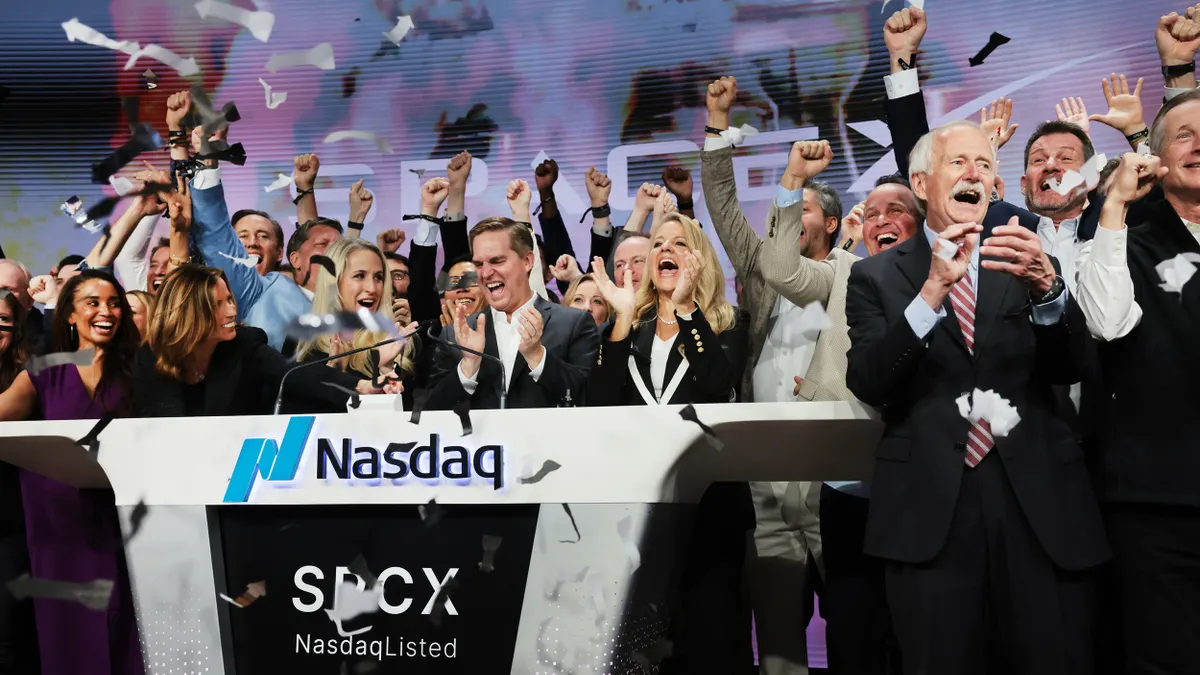
SpaceX’s initial public offering raises retention challenges for key leadership whose stakes in the $2.1 trillion-valued satellite and spacecraft maker enabled them to reach new heights of personal wealth.
CFO Bret Johnsen, a 15-year veteran of the newly-public company, owned over 9 million Class A common shares in the space exploration business before SpaceX’s historic IPO on Friday, according to the company’s prospectus. Its IPO closed at $160.95 per share — vaulting the finance chief’s net worth to about $1.4 billion, as well as making founder Elon Musk the world’s first trillionaire, according to reports.
But “once an employee reaches that level of wealth creation, retention becomes a real issue,” Shawn Cole, president of boutique executive search firm Cowen Partners told CFO Dive in an emailed response to questions.
Anyone looking for clues to the future C-suite’s staying power should pay close attention to SpaceX’s retention policies for its executives in the wake of its hotly-anticipated public offering, Cole said. That could include examining whether there are additional retention incentives in place for the CFO or how much of the finance chief’s wealth is tied to his continued service or the company’s future performance, he said.
Johnsen is a long-time employee of the Musk-led company, joining as its CFO in 2011 — when the company began to contemplate a public offering, according to a press release at the time announcing his hiring. An alum of Broadcom — where he served as corporate controller for eight years — Musk cited Johnsen’s expertise at “high profile, publicly-held technology companies” as “invaluable” for the future growth of the company, according to the release.
His recent jump in personal wealth means he “may not stay CFO for long,” Cole said. “Why would he? Look at Zach Kirkhorn.”
Kirkhorn, who worked 13 years at Musk-run company Tesla, served as the electric vehicle company’s CFO for four years and departed from the role with a net worth of $590 million in 2023, CFO Dive reported at the time. Tesla completed its IPO in 2010.
In a common pattern for Musk-led companies, much of those millions represented Tesla stock and options owned by Kikhorn — who, for example, earned $16.3 million in stock awards for 2022, CFO Dive previously reported. His successor, Vaibhav Taneja, became one of the most highly-paid finance chiefs in 2024 with a $139 million pay package largely consisting of stock awards and options, CFO Dive reported.
The bulk of Johnsen’s compensation for 2025 also consisted largely of stock options, with total compensation of $9.8 million comprised of a $825,000 base salary with the remainder represented by such options, according to the prospectus document.
The document filed Friday with the Securities and Exchange Commission also sketches out future compensation plans for Johnsen, which may indicate the spacecraft creator has already moved to further incentivize the Broadcom alum to hold onto the top financial seat he has held for 15 years.
His long-term incentive award for SpaceX’s fiscal 2025 was comprised “exclusively” of options to purchase 324,325 Class A shares of stock, granted by its board on May 10 of that year. The award is set to vest as to 40% in equal month installments from Jan. 1, 2027 to Dec. 1, 2027 and as to 60% equal monthly installments from Jan. 1, 2028 to Dec. 1, 2030, “in each case subject to Mr. Johnsen’s continued employment with us through the applicable vesting date,” the company said.
In January, the space technology company’s board also approved an amendment to a 2024 grant of 4 million performance based stock options given to Johnsen which, “In lieu of vesting based on free cash flow achievement in excess of a baseline, 371,125 of the stock options will vest for each $10 billion in adjusted EBITDA achieved during the 2025 through 2029 fiscal years,” according to the document.
For the purposes of the award, SpaceX is defining EBITDA as income from operations, excluding depreciation and amortization; share-based compensation; impairment; and restructuring impacts, according to the SEC filing.
Tying performance incentives to EBITDA makes sense in high-growth, capital-intensive companies with “enormous investment requirements,” Cole said. In such a case, meaningful free cash flow may not materialize for some time, making EBITDA a more “practical measure” for operating performance or scale, he said.
For SpaceX’s fiscal 2025, the company reported adjusted EBITDA of $6.5 billion, and a loss from operations of $2.5 billion, according to the Friday filing.
While EBITDA is a common incentive metric for executive compensation, “performance-based stock options tied to very large, absolute adjusted EBITDA tranches are less common,” Cole said. “That structure is typically more tailored to high-growth, pre-public companies, and we see it frequently in private equity-backed businesses, not public.”
However, the arrangement tracks broadly with the way Musk-led companies have “historically emphasized ambitious operating milestones,” Cole said, noting retail investor participation in SpaceX’s IPO was also “largely limited, which changes the public-market dynamic somewhat.”
As such, “the compensation structure may face scrutiny, but not necessarily the same kind of broad retail pressure that comes with a more traditional public offering,” he said. “It will be interesting to watch whether these goals are achievable and sustainable, particularly as the company operates with greater disclosure expectations and public-market scrutiny.”