Dive Brief:
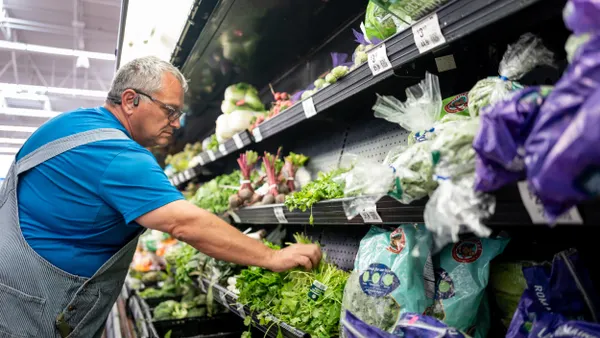
- Trump administration tariffs pushed up consumer goods prices by 2.9 percentage points from early 2025 through February this year, Federal Reserve Bank of New York researchers said, noting that prices would have fallen without the import taxes.
- After a year, consumer goods prices rise by about 0.25% for every percentage point increase in average tariffs, the researchers said, citing price gains among 67 groups of consumer goods included in calculations of the Consumer Price Index.
- A year elapsed before consumers felt the full impact from import taxes imposed early last year, the researchers said. “Tariffs pass through to import prices nearly completely in the first month,” they said. “The indirect channels build more slowly, as higher input costs and reduced competitive pressure gradually cause domestic producers to raise prices.”
Dive Insight:
Persistent price pressures, fueled by the highest U.S. tariffs since the 1930s and a war-induced surge in fuel prices, have dimmed consumer perceptions of affordability and stirred up expectations that inflation will accelerate.
Expectations among consumers for inflation 12 months from now rose to 4.7% this month from 4.6% in September, the University of Michigan said Friday, citing a survey.
The number “substantially exceeds the 3.4% seen in February before the Iran conflict began, along with all 2024 readings,” Joanne Hsu, the university’s surveys of consumers director, said in a statement.
Long-run inflation expectations also rose 0.1 percentage point this month to 3.5% from 3.4% last month, well above the range of 2.8% to 3.2% in 2024, Hsu said.
“Inflation expectations over both time horizons increased for the second straight month to their highest readings since May,” she said.
Fed officials closely track expectations for inflation, believing such sentiments can become self-fulfilling. Surveys by the Conference Board and New York Fed last month also showed that households expect price pressures to increase.
“I am concerned that the recent acceleration in inflation — after what soon will be five and a half years of it above the FOMC's [2%] target — will lead consumers, investors and price-setting businesses to revise up their expectations for future inflation,” Fed Governor Christopher Waller said in a speech Thursday, referring to the policy-setting Federal Open Market Committee.
Rising inflation expectations and concerns about affordability will likely influence voters during the Nov. 3 mid-term elections, according to findings in recent surveys.
Most Republicans and Democrats rank the cost of living as their No. 1 concern, and 78% of Americans blame President Donald Trump’s policies for price gains that are outpacing their wages, according to results of a Reuters/Ipsos poll released Friday.