Dive Brief:
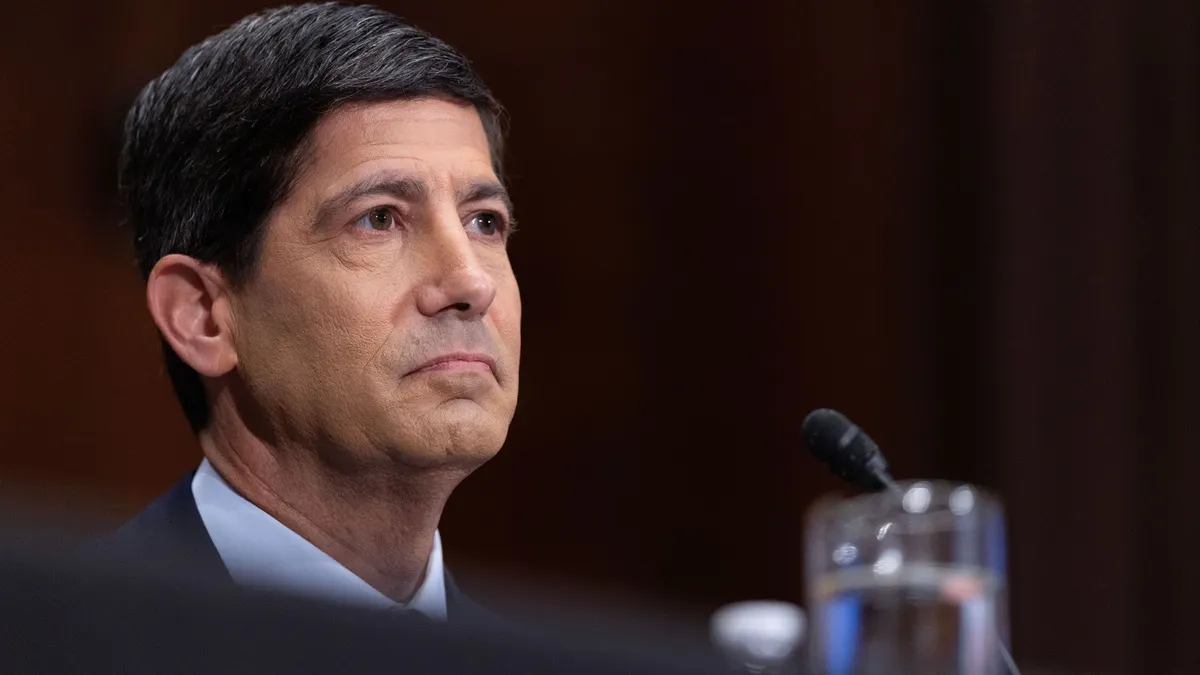
- Federal Reserve Chair Kevin Warsh on Friday pledged to ease price pressures, noting that higher interest rates may be necessary with inflation having persisted above the central bank’s 2% goal for more than five years.
- Warsh said he “would be hard pressed to describe broad financial conditions as restrictive.” Although he set a hawkish tone, Warsh did not indicate whether he will call for an increase in the federal funds rate at the next meeting of policymakers scheduled for Sept. 15-16.
- “We must be confident that underlying inflation is moving to our objective, clearly and at sufficient speed,” he said. “Otherwise, we have work to do. That's our job...our mandate...and our charge to keep.”
Dive Insight:
The comments by Warsh prompted traders in interest rate futures to increase the odds that policymakers will push up the benchmark rate at their September meeting. They see a 57.5% probability of a hike compared to 35.4% on Thursday, according to CME Group’s FedWatch tool.
Traders overreacted, EY Chief Economist Gregory Daco said.
“It is not obvious that Warsh is in the hike camp,” he said in a note.
Warsh “simply noted the views that were shared in the minutes from the” meeting of the Federal Open Market Committee in July, Daco said. “Given expected inflation and employment trends, we maintain our view that the Fed stays on hold through year-end.”
Three Fed policymakers concerned about inflation dissented against a decision last month to leave the federal funds rate unchanged. They called for a quarter-point increase in the main rate from the current level between 3.5% and 3.75%.
During the July 28-29 policy meeting, several central bank officials voiced concerns about price pressures and noted that the central bank may need to raise the main rate in the future, according to minutes of the gathering.
A few central bank officials in recent weeks, including Boston Fed President Susan Collins, have voiced an inclination to raise the main interest rate if inflation persists at its current level.
Inflation held steady last month because of tariffs, the U.S.-Iraq conflict and a months-long surge of investment into artificial intelligence.
The personal consumption expenditures price index, the Fed’s preferred measure of inflation, rose 0.2% in July and 3.3% from a year earlier, according to the Bureau of Economic Analysis.
After noting the 4.1% six-month gain in PCE, Warsh said, “the responsibility for 65 months of sustained, elevated inflation sits squarely with the central bank. And that is where it belongs.”
Referring to the other half of the Fed’s dual congressional mandate, Warsh said, labor markets are stable and “consistent with full employment.”
“The jobless rate, at 4.1%, remains low by historical standards and has not changed much for a couple of years,” he said.
The economy shows signs of stability, Warsh said.
“I am impressed by the overall performance of the economy, which appears to have strengthened,” he said.
“One indicator of strength is how well an economy holds up to shocks,” Warsh said, adding “on that score, both Main Street and Wall Street have been remarkably resilient.”