

A trend-following approach is often viewed as primarily suited for defensiveness, while otherwise being neutral, or even detracting, from portfolio returns. We sought to challenge this long-held belief, by exploring what drives the crisis alpha of trend-following and assessing how it can be preserved while improving overall return potential. Specifically, we examine whether crisis alpha is driven by the relative value investments implied by trend positioning within asset classes or beta-timing decisions—namely, whether to be long or short across asset classes. We believe this to be a crucial issue to understanding how the stability and overall return of a trend strategy might be improved while still preserving its valuable defensive characteristics.
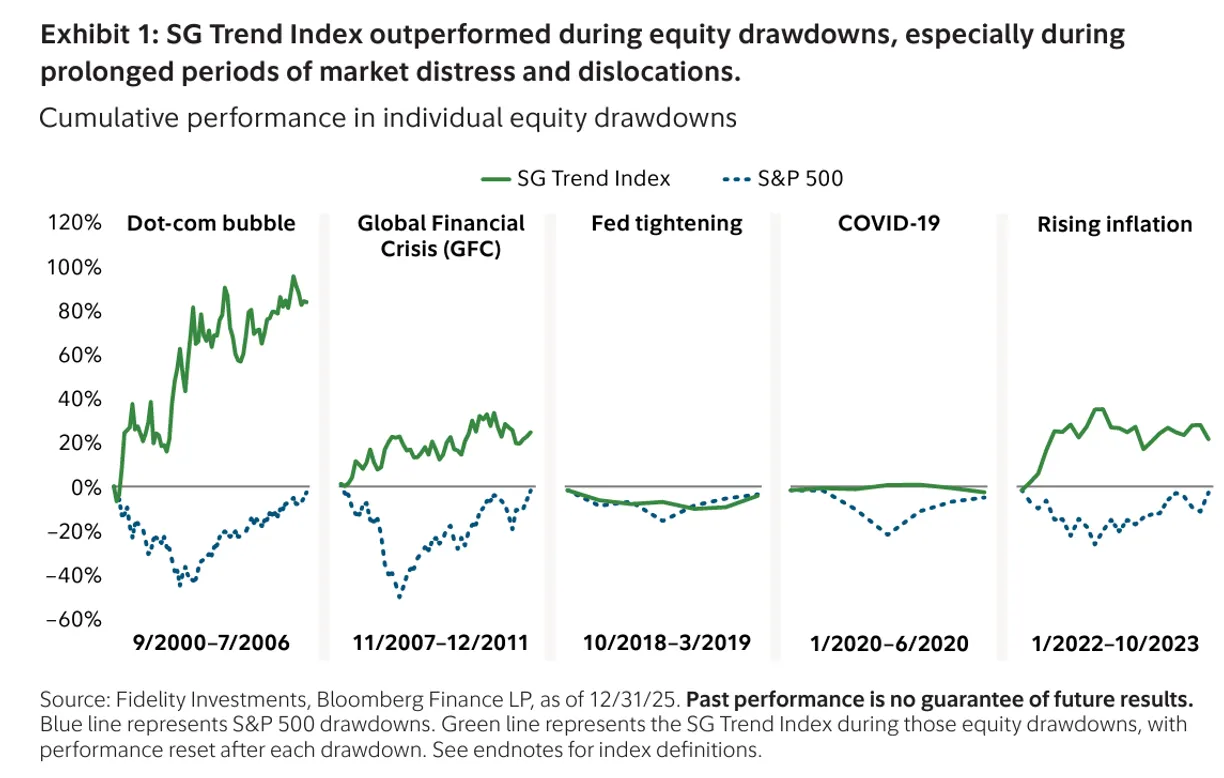
As illustrated in Exhibit 1, trend-following strategies, as represented by the SG Trend Index, have performed very strongly relative to the S&P 500 during equity drawdowns, particularly during major financial dislocations since 2000. This performance is the basis for the term “crisis alpha,” which captures their core return profile.
In our research, we created a hypothetical trend-following model and decomposed it into beta timing decisions (whether long or short, and by how much) and relative value decisions (whether long or short one market versus another). We evaluated the results of those two separate hypothetical sub-portfolios, finding that 76% of the risk and 78% of the excess return, comes from the beta-timing rather than the relative value component.2 Beta-timing decisions also drive most of the prototypical characteristics of trend-following approaches, including the crisis alpha profile. Specifically, we found that on average across asset classes, the beta-timing component was more than twice negatively correlated to equity compared to the relative value component. Crisis alpha with a higher return potential | 2 Crisis alpha with a higher return potential | 3 These results raise the question of whether it is possible to preserve the crisis alpha defensive characteristics while enhancing trend strategies with a richer set of alpha signals. Our research suggests that it is indeed possible to completely replace the relative value component with a significant allocation to another, higher Sharpe ratio relative value strategy, and keep most of the crisis alpha benefits of the strategy. That is the key finding of this paper. If you want trend following crisis alpha but also want a strategy with higher average return—particularly in markets where equities are thriving—our research analysis suggests it’s possible to have both.
Conclusion
In our research, we created a hypothetical trend-following model and decomposed it into beta timing decisions (whether long or short, and by how much) and relative value decisions (whether long or short one market versus another). We evaluated the results of those two separate hypothetical sub-portfolios, finding that 76% of the risk and 78% of the excess return, comes from the beta-timing rather than the relative value component.2 Beta-timing decisions also drive most of the prototypical characteristics of trend-following approaches, including the crisis alpha profile. Specifically, we found that on average across asset classes, the beta-timing component was more than twice negatively correlated to equity compared to the relative value component. Crisis alpha with a higher return potential | 2 Crisis alpha with a higher return potential | 3 These results raise the question of whether it is possible to preserve the crisis alpha defensive characteristics while enhancing trend strategies with a richer set of alpha signals. Our research suggests that it is indeed possible to completely replace the relative value component with a significant allocation to another, higher Sharpe ratio relative value strategy, and keep most of the crisis alpha benefits of the strategy. That is the key finding of this paper. If you want trend following crisis alpha but also want a strategy with higher average return—particularly in markets where equities are thriving—our research analysis suggests it’s possible to have both.