Dive Brief:
- The consumer price index, excluding volatile food and energy prices, edged up 0.1 percentage point last month to 0.3%, the Bureau of Labor Statistics said Friday, exceeding forecasts and increasing the odds that the Federal Reserve will raise borrowing costs next week.
- Several components in core CPI rose in August, with airline fares increasing 2.7% and communication costs rising 2.3% after a 0.6% gain in July, the BLS said. Shelter and transportation services increased 0.3% and 0.5%, respectively. CPI for all items held steady on an annual basis at 3.4%, the same pace as in July.
- “The CPI data indicates the disinflation process is at risk,” EY Parthenon Chief Economist Gregory Daco said, forecasting that core CPI on an annual basis will end the year at 2.6%. The Fed will probably raise the main interest rate by a quarter-point on Wednesday and by another quarter-point at a meeting in December, Daco said in a note.
Dive Insight:
A mix of economic data and Trump administration decisions has strengthened the argument among Fed officials who, after more than five years of inflation exceeding the Fed’s 2% goal, favor raising the federal funds rate from its current range from 3.5% to 3.75%.
President Donald Trump has imposed a new round of tariffs in the past several weeks, focusing especially on Canada, the second largest U.S. trade partner after Mexico.
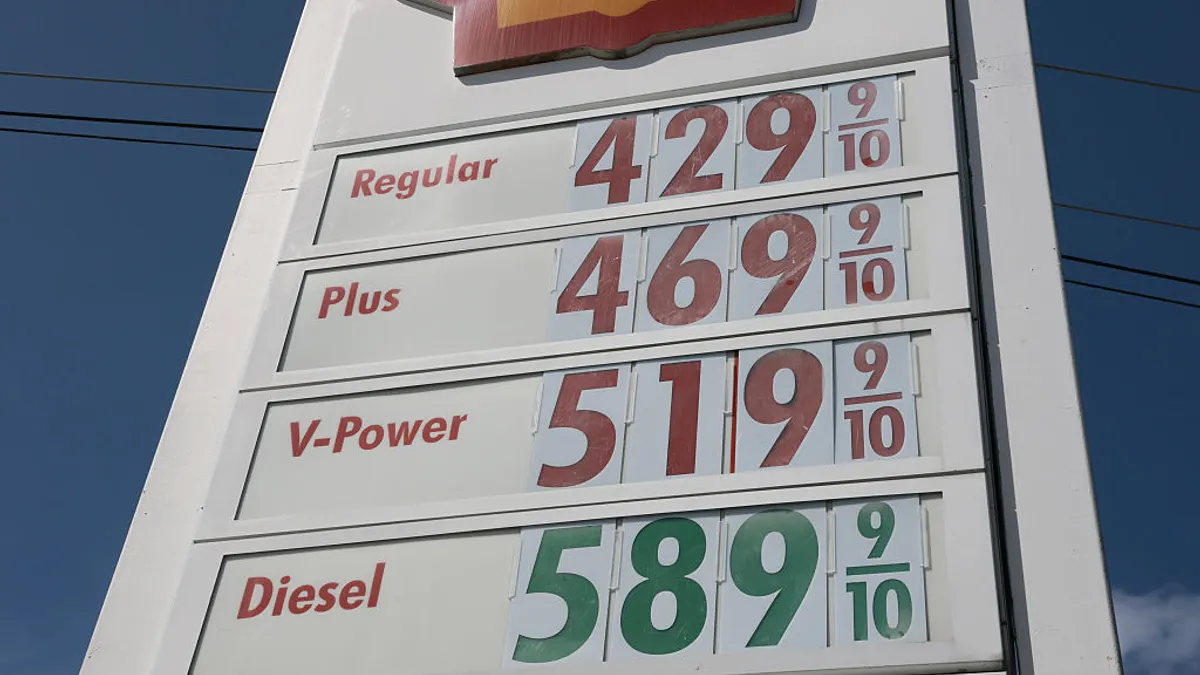
Meanwhile, energy prices have surged during the past month, with the price of Brent crude oil rising 18% to $104.96 per barrel amid sporadic fighting between U.S. and Iranian forces.
Energy prices increased 2.1% in August, with gasoline rising 3.9% and fuel oil surging 10.1%, the BLS said.
Higher energy prices helped push up the producer price index by 0.4% last month, indicating that the personal consumption expenditures price index — the Fed’s preferred inflation gauge — may persist at a level unacceptable to policymakers.
Also, recent strength in the job market allows Fed officials to focus on their congressional mandate to achieve price stability. U.S. employers added 162,000 jobs last month and unemployment held steady at 4.1%.
The CPI data released Friday prompted traders in interest rate futures to increase the odds that policymakers will push up the main rate on Sept. 16 to 86.5% from 72.4% on Thursday, according to CME Group’s FedWatch tool.
Three Fed regional bank presidents in July dissented from a Federal Open Market Committee decision to hold the main rate steady, calling for a quarter-point increase.
During the Sept. 15-16 FOMC meeting, only one or two policymakers will probably dissent in favor of holding borrowing costs steady, Daco predicted.
Fed Chair Kevin Warsh “will likely use the cover of the majority to lead from behind and also vote for a hike,” Daco said.
Recent surveys show that consumers are growing increasingly worried about inflation.
“With a resurgence in fuel prices and trade tensions, consumers anticipate greater pressures on their pocketbooks to come,” Joanne Hsu, surveys of consumers director at the University of Michigan, said Friday, noting a decline in household sentiment this month.
“Overall, sentiment is now 16% below February, prior to the start of the Iran conflict, and 13% lower than a year ago,” Hsu said in a note.
Consumers are more pessimistic about future price pressures, she said, noting that year-ahead inflation expectations jumped from 4% in August to 4.6% this month, the highest reading since June.
Long-run inflation expectations, a top concern among Fed officials, edged up this month to 3.4%, ending three straight months at 3.3%.