Dive Brief:
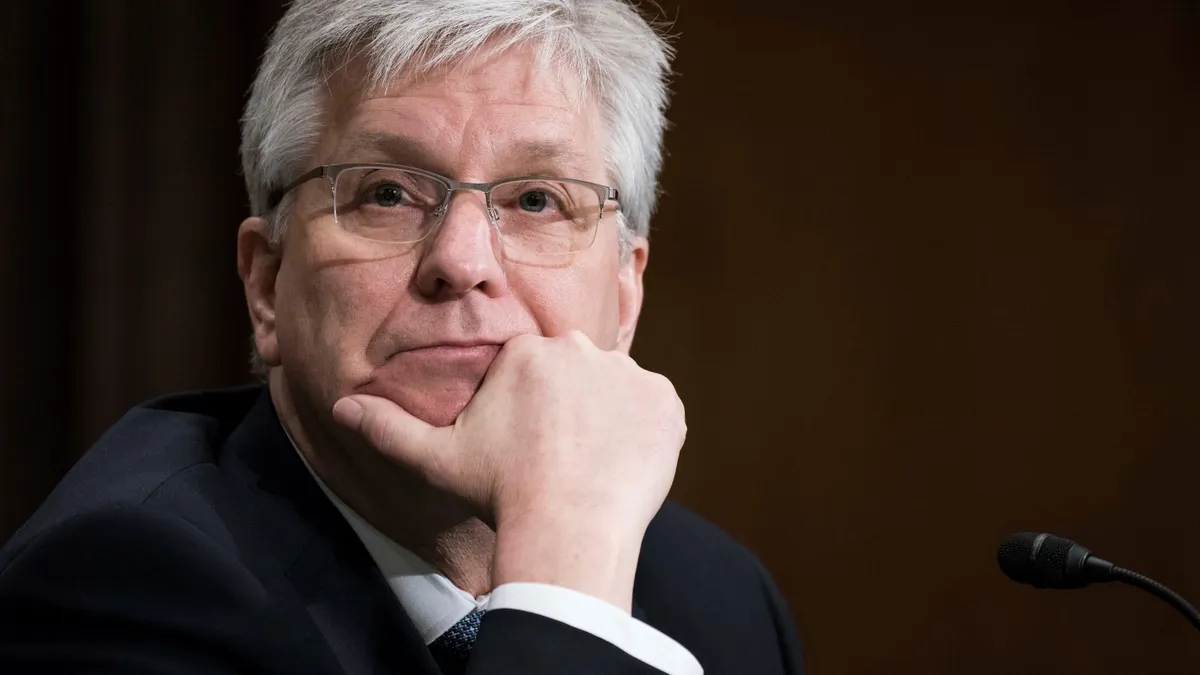
- Federal Reserve policymakers are “at a crossroads” and may soon need to raise the benchmark interest rate as inflation heats up and persists above the central bank’s 2% target, Fed Governor Christopher Waller said Monday.
- “If we get another hot reading on core inflation this week, then the FOMC [Federal Open Market Committee] will need to consider tightening monetary policy in the near term,” Waller said in a speech.
- “I am concerned about the elevated pace of core inflation this year, which has steadily moved up — as measured by the 12-month personal consumption expenditures (PCE) rate — from 3% in December 2025 to 3.4% in May,” he said.
Dive Insight:
Even as inflation exceeded the Fed’s goal, Waller last year pointed to signs of a weakening labor market and called on his fellow policymakers to cut the federal funds rate. The central bank trimmed the main rate by a quarter percentage point three times from September to December.
Since then the policy landscape has shifted, Waller said, noting “data in recent months support the idea that the labor market is stable and balanced.”
At the same time, “no matter how you cut it, or what measure you want to use, inflation is up this year,” he said.
“When inflation is well above its target and the labor market is near full employment and stable, any serious policy rule calls for raising the policy rate to bring down inflation,” Waller said. “Sternly staring at inflation until it melts before our withering gaze is not an option.”
Traders in interest rate futures on Monday saw 43.3% odds that the Fed will raise the federal funds rate by a quarter percentage point at their next two-day meeting ending July 29, according to the CME Group’s FedWatch tool. On Friday they saw a 34.2% probability of such an increase.
The comments by Waller aligned with those on June 16 by Kevin Warsh who, during his first press conference as Fed chair, repeatedly emphasized that the central bank aims to curb price pressures, ending a five-year period of above-target inflation.
“I am monitoring price movements and am alert to the risk that the increase in core inflation is a sign that inflationary pressures are spreading through the economy,” Waller said.
“The FOMC has to be ready to tighten monetary policy to prevent a repeat of the 2021-to-2022 inflation episode,” Waller said. During most of 2021 many Fed officials incorrectly said rising price pressures were “transitory.”
“Looking ahead, I do expect a deceleration of headline inflation due to declining oil prices, starting with the inflation data we get this week,” he said.
“But I will be focused on core inflation, and on that count, there are recent signs of continued pressure on goods prices,” Waller said. Data on core inflation excludes volatile food and energy prices.
The Bureau of Labor Statistics on Tuesday is scheduled to release data on the consumer price index for June.
While flagging inflation risks, Waller said the economy appears to be in good shape.
“Spending by households and businesses has been resilient, despite higher goods costs generated by tariffs and the surge in energy prices from the Middle East conflict,” he said. “The labor market has also been stable, with employment close to the Federal Open Market Committee's maximum-employment goal.”