

What are equity extension strategies?
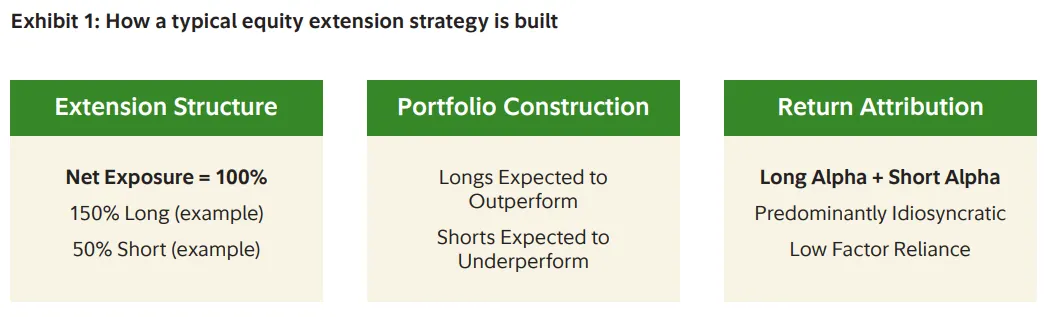
Equity extension strategies seek to generate total return above that of the benchmark without increasing overall market risk. An equity extension portfolio combines long positions in securities expected to outperform with short positions in securities expected to underperform. Proceeds from the short sales enable these strategies to fund additional long positions and/or express higher conviction in existing long positions, creating an “extension” above a 100% longonly exposure. For example, the proceeds from a 50% short position may be invested in long positions to create a 150% long position.
What institutional investors like about extension strategies
Equity extension strategies can help improve portfolio efficiency by allowing active investment in both positive and negative security-level views, rather than relying solely on relative overweights and underweights in a traditional long-only framework. When implemented carefully, equity extension strategies can allow stock selection to play an expanded role in driving returns without materially altering the portfolio’s overall risk profile.
Potential benefits of equity extension strategies may include:
- Better risk-adjusted returns driven by the increased flexibility to invest in long-alpha and short-alpha ideas.
- The ability to generate alpha in both rising and falling markets.
- Increased portfolio efficiency relative to traditional long-only portfolios, partly due to the removal of benchmark tracking and portfolio construction constraints.
How extension strategies have evolved
Equity extension strategies that focused on quantitative investment processes gained popularity in the early 2000s. More recently, improvements in data availability, portfolio construction, and risk management have enabled more targeted implementations, which have increased investor interest in approaches that emphasize security-specific insights and eliminate reliance on traditional factor bets and sector exposures.
We believe Fidelity’s Fusion Alpha strategy is different
Fidelity Fusion Alpha Equity Extension systematically captures security-level insights from Fidelity’s fundamental research analysts, portfolio managers, and alternative data. The strategy focuses on identifying and investing in idiosyncratic return opportunities—both long and short, rather than relying on factor bets or style tilts. A Fidelity paper titled “Unlocking alpha,” describes in detail how the Fidelity Quantitative Research and Investments (QRI) team generates and leverages these signals.
Fidelity Fusion Alpha Equity Extension draws on three categories of differentiated data
- Fidelity analyst research: It leverages internal analyst ratings, estimates, research notes, price targets, and paper portfolios.
- Portfolio manager data: The Fidelity QRI team tracks and generates signals from active fund weightings relative to each respective benchmark on stock positions that represent about 85% of available equities.
- Alternative data: Long-term growth and earnings forecasts, point-of-sales data, geolocation data, and more are used to predict key performance indicators for companies.
How the portfolio is constructed
The strategy is typically implemented using a 150/50 structure. The split can vary, but it often seeks 150% long exposure funded by 50% short exposure, resulting in a net exposure close to 100%. Short positions are selected based on the same fundamental framework as long positions and are an integral part of the return-seeking process, rather than a byproduct of risk management. QRI testing indicated that 150/50 it is the optimal portfolio for the alpha model and best leverages the uncorrelated alpha signals.
The portfolio targets an information ratio greater than one and seeks to deliver excess returns from idiosyncratic risk, not factor bets. This is important because, as noted earlier, the higher the allocation to market factors, the greater the source of hidden volatility. Unintended exposures to specific factors (mid-caps, value, growth momentum, and more) can erode portfolio performance and, if left unchecked, cause portfolios to drift away from a strategy’s stated risk parameters and return goals.
What is different about Fidelity’s equity extension strategy
Fidelity’s strategy is 1) systematic in nature, 2) fundamentally driven, 3) scalable, 4) differentiated, and 5) capable of generating returns from idiosyncratic risk.
Taking these one at a time …
- Systematic nature means the strategy is process driven, and devoid of any discretionary changes from management. It is a systematic implementation of Fidelity’s fundamental intellectual property.
- Fundamentally driven means that the Fidelity QRI approach leverages proprietary fundamental data, unlike quantitative strategies based on factors.
- Scalable means the strategy can add value for clients with substantial portfolios. This also is the case as portfolios grow over time.
- Differentiated means it benefits from a proprietary research approach (one that will not be shared outside of Fidelity).
- Capable of generating returns from idiosyncratic risk means that it targets 90% to 95% of the risk coming from idiosyncratic, or stock-level, sources.
What the Fidelity Fusion Alpha Equity Extension may offer investors
The strategy can either complement or replace core equity allocations, seeking incremental return potential without changing overall equity exposure.
How leverage and shorting work in the Fidelity strategy
The QRI team uses a methodical approach to managing long and short positions and the acompanying risks. This includes:
-
Oversight and risk management that’s integrated into all aspects of the investment process (alpha modeling, optimization, portfolio construction, trading, and more).
-
Understanding that shorting changes the risk relationship, and that it differs from underweighting versus the benchmark position. Shorting requires a robust short-selling infrastructure and rigorous oversight, which the QRI team possesses.
-
Awareness of concentration risk and degrees of freedom from the benchmark relative to a longonly portfolio, and the fact that a 150/50 strategy can lead to greater diversification.
At Fidelity, our investment approach reflects decades of fundamental research, a deep reservoir of investment talent, and a disciplined, systematic process that seeks to translate differentiated insights into consistent, repeatable performance outcomes.
By focusing on idiosyncratic return sources and carefully managing leverage and short exposure, Fidelity Fusion Alpha Equity Extension can help clients potentially earn more from their core equity exposure without changing its role in the portfolio. Fidelity Fusion Alpha Equity Extension is fundamentally driven, systematically managed, scalable and intentionally constructed to avoid unintended factor exposures, allowing stock selection to be the primary driver of results.