It’s been a busy year for PicPay. The São Paulo-based digital bank and mobile banking app provider made a splash in January when its parent PicS N.V.’s initial public offering raised over $400 million and became the first Brazilian company in four years to go public in the U.S.
There have also been challenges. News broke this summer that Brazilian prosecutors are investigating alleged payroll fraud in the country's capital city involving PicS NV and Banco de Brasilia SA. Additionally, the company’s already languishing stock was slammed again this week as Brazilian markets were routed after Brazilian President Luiz Inácio Lula da Silva’s re-election rattled investors.
Last week PicPay’s new CFO discussed the tailwinds and the headwinds that the company is riding in an interview with CFO Dive. A fintech veteran, the 40-year-old André Cazotto joined the company in 2021 as head of investor relations. He was promoted to finance chief in August after spending years presenting the company to investors and helping it to go public.
In addition to overseeing his financial team, Cazotto said he is focused on helping drive the company’s mandate for growth. Having started out as a platform for merchants, PicPay has evolved into a digital bank that aims to give Brazilian consumers the ability to access all their financial information while also cross-selling products to meet customers’ wide-ranging financial needs.
“Our core focus right now is to consolidate PicPay as one of the largest digital banks in Brazil,” he told CFO Dive, noting that the company, founded in 2012, sees much more potential for growth beyond the large and profitable digital wallet that it already has become. “We feel that we're just starting to scratch the surface with a huge opportunity to become much larger in Brazil.”
Low and grow strategy
PicPay is betting big on Brazil. It is hoping to draw more customers in a country with a population of 213.4 million . Citing ACI Worldwide data, Brazil is also expected to rank as the second largest country for real-time payment transactions per individuals by the end of 2027, at 51.8 transactions per person, according to the company’s Jan. 20 F-1 filing with the U.S. Securities and Exchange Commission.
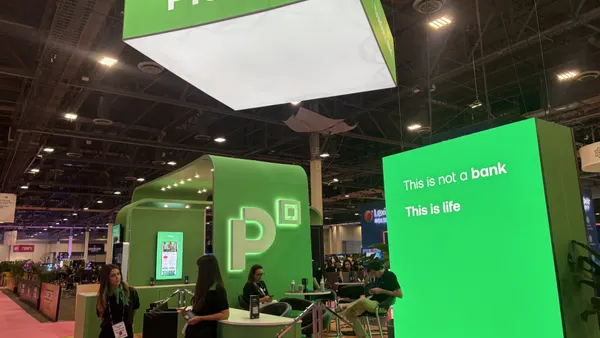
Wearing a black polo shirt and black pants, Cazotto seemed at ease as he sat down with CFO Dive near the company’s bright green booth during the Money20/20 financial conference in Las Vegas last week. He wasted no time before logging into the app on his own cell phone to demonstrate how PicPay’s users can navigate their finances on what the company dubs its “super app” in real time. He also detailed the company’s playbook for expanding its engagement with customers to ultimately grow its digital bank footprint.

Cazotto looks to expand its offerings to the regular users of the company’s digital wallet. “I already have enough information to provide you a credit card or a personal loan and over time if you become a good payer I can increase your credit limit,” he said, noting that the company extends a relatively small credit limit equivalent to $50 to $100 USD. “We have a low and grow strategy,” he said.
As for some of the challenges, Cazotto has said that Brazil’s Federal District investigation into alleged “improper payroll deductions affecting public servants” stems from a misunderstanding of a salary advance product offered by the company. It was not a payroll loan or a credit product, the company said in a June 22 press release.
“At the end of the day it was a big misconception about the product that we offer,” Cazotto told CFO Dive, adding that the company is comfortable with its defense, though unclear regarding when the matter will be resolved.
He also attributed the stock volatility this year in part to growing concern about the credit cycle as well as about the economy in Brazil.
Investors are focused on the current credit cycle and how it will impact PicPay along with all lenders in the country, he said. “Household indebtedness remains elevated in Brazil, interest rates are higher for longer periods, so there is this overconcern about…how this will affect the future growth of fintechs in Brazil,” he said. “It’s a more macro issue rather than something specific for the company.”
So far this year, PicPay shares trading on the Nasdaq under ticker symbol PICS are down roughly 60%, closing at $7.86 on Thursday amid the Brazilian market’s sell-off this week.
In a Wednesday email after the election, Cazotto expressed continued confidence in the company’s strategy.
“The recent volatility has impacted the broader Brazilian equity market, but our focus has to remain on what we can control: execution,” he wrote to CFO Dive. “Since the IPO, we have consistently delivered above the guidance we shared with the market, reinforcing our confidence in our strategy and long-term vision.”
Similarly, Citi analyst Gustavo Schroden said in an email Thursday that Citi has maintained a buy rating on the company and pegs the target price for PicPay stock at $24.
“Our investment thesis assumes PicPay continues to expand its client base in Brazil while increasing credit origination, pursuing a balanced mix of secured and unsecured loans and deepening penetration within its existing customer base,” Citi wrote in a Feb. 23 report. “At the same time, asset-light fee income from products such as transactional services, insurance, and investments should contribute positively to margins.”
In its most recent earnings period, PicPay total number of accounts rose 10% year-over-year to 70.4 million while its adjusted net income jumped 135% to R$283 million ($52.5 million).
Playing the AI cards
Just months into the job, Cazotto said he is focusing on AI and capital allocation. He has a sharp eye on AI budgets, seeking to use a variety of vendors so he isn’t stuck with taking their prices. He hopes that will give the company freedom to drive better deals in its AI contracts.
“We decided to be an agnostic player, pretty much operating with different models and this is helping us to reduce the cost per token,” he said, declining to disclose what the company’s total AI budget is. “We can negotiate better deals, we also try to work with some names that maybe aren’t very known in the US market.”
The Brazilian digital bank is working with large and newer smaller AI vendors, with some based in the U.S. and China. OpenAI’s ChatGPT is used in PicPay’s customer service department, enabling the company to serve its customers with a roughly 300-person call center staff compared to the thousands Cazotto believes it would have needed to handle the work without AI.
The company also pushes its workers to find ways to replace vendors and it offers financial incentives to encourage employees who find ways to develop PicPay’s own AI models. It has also recruited talent to take on such tasks: Each of its 15 business units has its own chief technology officer, he said.
“We have this kind of challenge for CTOs,” Cazotto said. “Make sure it’s an open kimono. But if you think you can replace that specific [AI] supplier, we can use our agents to rebuild the model or renegotiate with the supplier.”
Looking beyond AI, Cazotto was candid when asked to name his biggest concerns as he takes on his new role. “Competition is something that keeps me up at night because you’re competing directly with giants,” he said. “It’s not an easy game.”