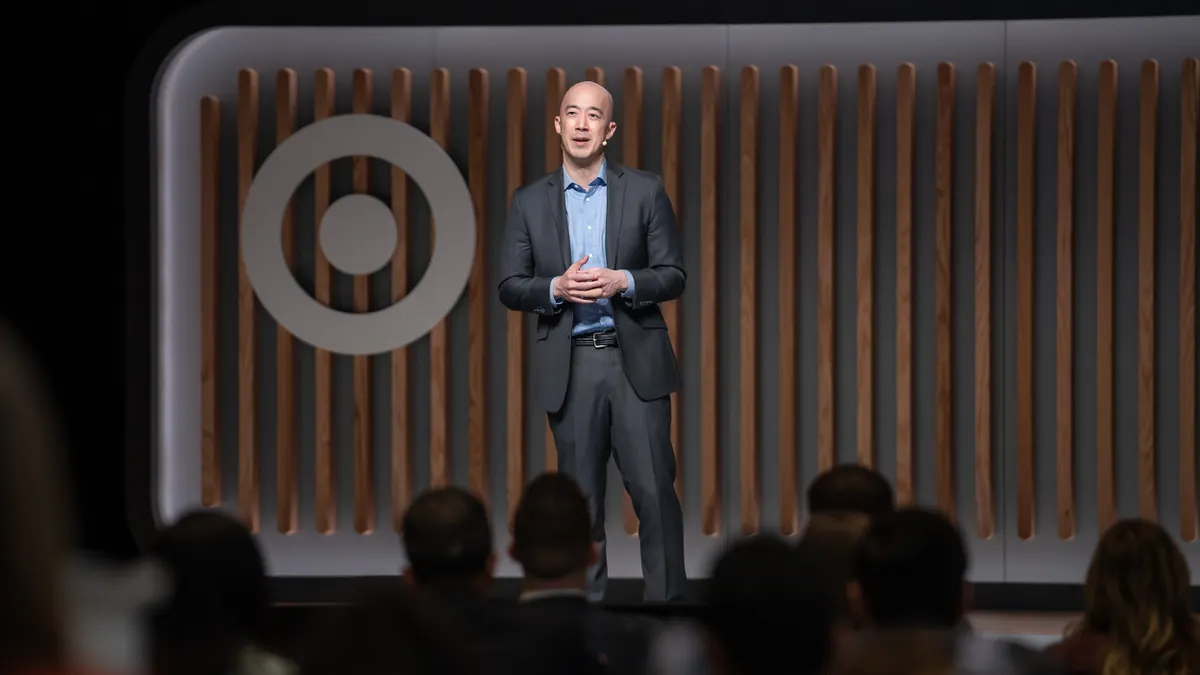
Target CFO Jim Lee will often pick up a Diet Pepsi or Celsius when he’s in the check-out lane, an old habit probably left over from the 26 years he spent at PepsiCo.
Like most shoppers, Lee usually has a mission when heading into a retail store, whether picking up groceries or clothing — and, like many who walk through Target’s doors under its now iconic red and white bullseye logo, “I always end up with something different,” he said.
“That’s the unique factor of [Target],” Lee, who stepped into the Minneapolis-based retailer’s top finance seat in September 2024, told CFO Dive. “We display things in a way that makes [them] more easy to discover and gives you destinations.”
CFO Dive spoke with Lee about what prompted his move to Target, his love of problem-solving — and lifelong love of Target — and the lessons learned during a career that has spanned across multiple financial and strategic roles in numerous countries.

Puzzles and PepsiCo
Part of Target’s “unique sauce,” as Lee sees it, is its wide assortment of products that enable its customers to get all their shopping done in one trip — whether they need groceries or need to be reminded that it’s time to buy seasonal fall decor. That standout space Target occupies in American retail was also part of what attracted Lee to take the CFO role in 2024 at the age of 50.
As a strategist and finance professional, “I was so excited about what Target represented as a company,” Lee, who is also responsible for enterprise strategy at the retailer, said. Combining the roles of finance chief as well as overseeing strategy is “a strong competitive advantage,” Lee, who has held a range of finance strategy roles throughout his career said.
With the combination, “I can help drive and dictate, where are the bets we're placing in service of our enterprise strategy, and where [are we] advantaged, and where should the investments and focus of the organization be?” he said.
A lifelong Target shopper, Lee, like many, grew up with the brand — during his time working overseas for the Purchase, New York-based PepsiCo, many stops back to the U.S. included a Target run. Lee has a photo that just happened to capture a routine family Target run in White Plains, New York, taken nearly a decade before he joined the company.
Still, the move represented a bit of a sea change for Lee, who had spent the bulk of his career in the consumer products space for PepsiCo and wasn’t expecting to leave.
Lee, who has always had an affinity for math and for solving problems, studied engineering with a concentration operational research at Princeton University, pivoting from his original goal of studying electrical engineering. He graduated in 1996 with a bachelor’s degree in engineering.
He joined the beverage company in 1998 as a director of strategy and finance after working as a strategic consultant for a few years following graduation.
“I’ve grown up loving to solve business problems, or solve problems — I don't think when I was a kid I was solving business problems,” Lee said.
With its focus on scenario planning, optimization, statistics and probabilities, the operational research concentration appealed to Lee, and shapes how he thinks to this day.
Combing through scenarios, probabilities and statistics is “a little bit underneath the hood of how I think and operate,” he said. “I'm always thinking, looking around corners and thinking about possibilities.”
Those skills were sharped by his experience at PepsiCo, where Lee held positions including as its deputy CFO, SVP of corporate finance and chief strategy and information officer.
From Russia with love
Lee’s time at the beverage and soda giant also included stints heading up finance for various international divisions, serving as PepsiCo’s senior director and CFO for Australia and New Zealand BU, CFO of its south East Europe Region based in Turkey, and SVP and CFO for PepsiCo Russia, Ukraine and CIS.
“My experiences both in Turkey and Russia were probably the most exciting because when you're working in Eastern European markets, there's always a macroeconomic crisis…where you’re having to make really rapid, big-pivot decisions,” Lee said.
For three years ending in July of 2016, Lee was based in Moscow as PepsiCo Russia’s CFO. During that time, the valuation of the Russian ruble plummeted due to drops in crude oil prices and international sanctions related to the country’s annexation of the Crimea, contributing to rapid economic upheaval and causing many companies, including PepsiCo, to close or move manufacturing plants and operations in the region, according to reports at the time.
It was a “learning environment” Lee said. “My first year was a little bit, candidly, a little bit overwhelming,” when it came to the pace of change, he said. However, “you sort of fall in love with the art of the possible and understanding [that] to operate in those markets, you just have to be dynamic, and you have to make decisions, and you can't wait for others,” he said.
“Learning the skill set to be comfortable in uncertainty was for me, that was probably the most formative four years I had in my career,” he said of Russia and Turkey.
Still, there were moments of quiet: Lee recalled a standout moment taking a selfie in Moscow’s historic Red Square, which was within walking distance from his apartment in the city.
“I remember distinctly one late evening, I just walked over there,” he said. “It was really cold, snowing, and I think I was literally the only person in the Red Square.”
“Learning the skill set to be comfortable in uncertainty was for me, that was probably the most formative four years I had in my career.”

Jim Lee
Target CFO
The consumer face-to-face
His 10 years overseas meant he had to be “pretty open-minded and dynamic, and pretty quick to the draw” when it comes to making decisions, Lee said — skills he’s putting to swift use at Target.
Still, the decision to join the retailer came with an adjustment period, both for Lee and for Target, which at the time was seeking to reverse a trend of declining sales and market share amid macroeconomic pressures and changing consumer habits.
“When you join a company, you're trying to assess, what have you walked into? What's the landscape? What's the industry?” Lee recalled of his start at Target. He had to adjust to the quirks of a new industry, understanding retail economics and getting used to a consumer that was a lot closer than before.
Retail is an industry that’s face-to-face with the consumer, so “things change on an hourly, daily basis,” Lee said.
During his two years at Target, Lee has stayed focused on hitting the company’s next chapter of growth — which, for him, means the ability to drive sustained growth quarter over quarter.
Since his hiring, Target has moved to adjust after a period of lukewarm performance, with slumping sales impacted by a pullback in discretionary spending and consumer boycotts related to DEI and social issues.
For instance, Target named company veteran Michael Fiddelke to its CEO chair at the start of this year, who swiftly detailed a four-point turnaround plan aimed at centering customer relationships.
Fiddelke, whose 20 years at Target included stints as its chief operating officer and as its CFO, stepped into its top executive chair on Feb. 1 and outlined his new strategy’s four top priorities in a company blog post. They include: leading with merchandising authority; oving to elevate its guest or customer experience; focusing on accelerating technology; and strengthening its teams and communities.
Under the plan, Target has moved to expand its footprint, targeting the opening of more than 30 new stores by the end of this year as part of a $5 billion capital investment plan, according to a March 5 press release announcing the opening of its 2,000th store location in North Carolina.
The new priorities themselves aren’t “mind-blowingly different” than the way the retailer previously operated, but they provide a key framework for Target to structure itself and figure out where it’s “uniquely positioned to win, because the temptation could be to try to do everything in retail.” said Lee, who worked with Fiddelke on the strategy.
“Retail is a very complex, competitive environment, and understanding the place you are differentiated and have the right to win is really critical,” he said.

Staying on target
While moving forward with Fiddelke’s four-point strategy, Target has continued to focus on its “sweet spot” of appealing to busy families, Lee said, lowering the price of more than 10,000 items and continuing to invest in redesigns. For instance, much of the company’s investment in its older stores is updating its inventory of food, introducing new fresh and frozen or produce offerings, he said.
Lee’s focus as CFO with the turnaround strategy is on ensuring Target is “putting our money and bets behind the areas where we are truly curating and having a differentiated point of view,” he said.
“Retail is a very complex, competitive environment, and understanding the place you are differentiated and have the right to win is really critical.”
Jim Lee
Target CFO
The company has funneled billions to refresh key areas of its stores to provide that curated experience, reporting capital expenditures of $1.4 billion in its second quarter primarily driven by remodels and new locations. That’s included the launch of Target Beauty Studio, a beauty focused area rolled out to 600 stores and on Target.com on Sept. 10, according to a press release.
For Lee, one of the best examples is Target’s “Fun 101 Hardlines” initiative, which focuses on pop culture, toys and related merchandise — taking “a historically quieter area of a store and then really making that a fandom destination,” he said.
“That was architected by saying, ‘are we trying to have a point of view here, or are we trying to do the same thing as everyone else, and where we are differentiated?’” Lee said.
During its most recent quarter ended August 1, Target reported net sales of $26.5 billion, a 5.3% jump from the prior year period, according to its second quarter earnings reported on Aug. 19.
While it’s still early days, Target is “showing positive progress so far,” gaining traction after “showing two consecutive quarters of positive traffic growth,” Brett Husslein, an equity analyst for Morningstar who covers the company told CFO Dive in an email.
Husslein credited Lee with a clear, straightfoward communication style on the business’ earnings calls, and noted that the upcoming holiday season will be an “important test of whether Target’s merchandising overhaul is translating into broader, more durable demand,” he told CFO Dive.
For Lee, the task ahead is simple: stick with the plan.
“As long as we keep on that trajectory, we have a strong likelihood to drive sustained growth,” he said. His role as CFO is “ensuring that we're constantly focused on prioritization of where we're going to put our resources — not just dollars, but also time and energy,” he said.