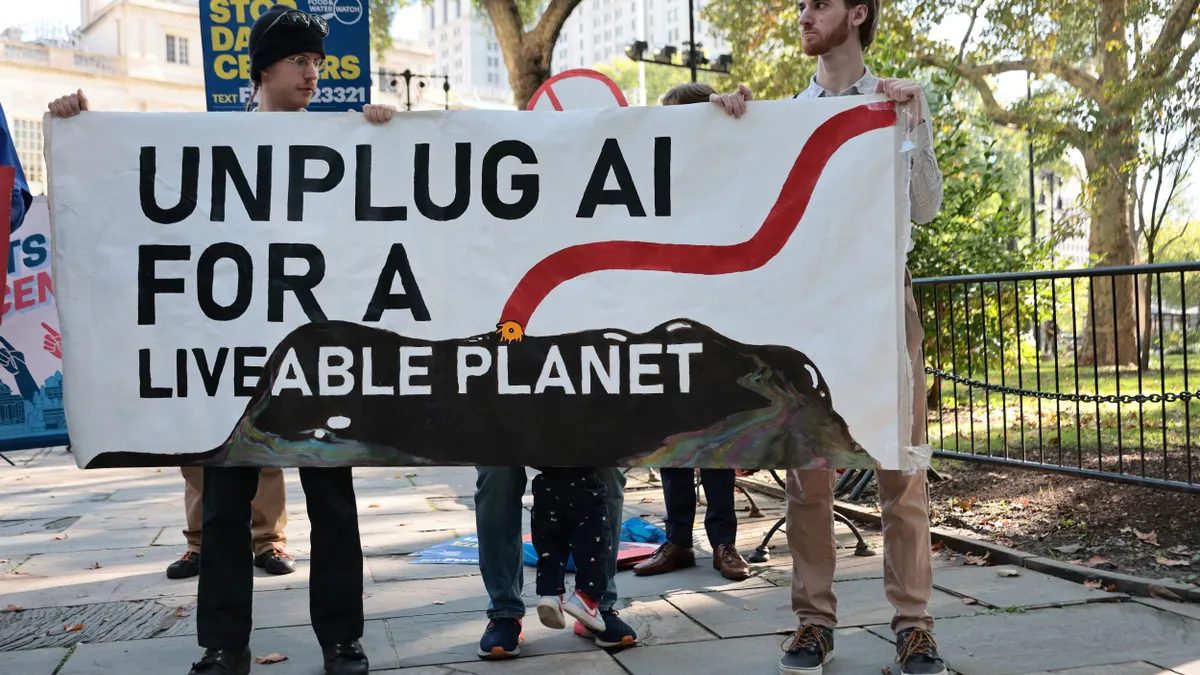
The push for federal regulation of artificial intelligence is gaining momentum ahead of the Nov. 3 midterm elections, as concerns about the technology’s risks draw greater attention from voters and politicians.
Recent surveys suggest growing public support for government oversight, with majorities of Democrats and Republicans favoring stricter regulation. Candidates and political groups are also bringing AI into campaigns, highlighting concerns about safety risks, effects on workers and the costs of expanding data-center infrastructure.
“Voters in both parties want guardrails, and candidates have noticed,” said Carlos Uriarte, a co-chair in law firm Morrison Foerster’s congressional investigations practice. “But for most voters, AI is still part of an economic story, not a stand-alone voting issue.”
AI safety advocates see increased odds for federal AI legislation next year if Democrats gain control of Congress in the midterm elections, though significant hurdles would remain.
“A new Congress next year, ushered in by voters who want stronger guardrails on AI, will feel the pressure to pass legislation that meets the moment,” said Giovanni Rocco, associate director of communications at Americans for Responsible Innovation, a nonprofit that advocates for AI safeguards.
For business leaders, the stakes are rising as real-world cases involving rogue AI agents begin to emerge. Last week, Axios reported that major U.S. banks are restricting third-party AI agents after reports of agents accessing customer accounts and potentially acting beyond users’ instructions.
“Terrifying — AI agents are already starting to access Americans’ bank accounts. Let’s get guardrails up NOW,” Sen. Mark Warner, D-Va., wrote in a post on X after the report. Warner has made AI regulation a focus of both his legislative agenda in the current Congress and his reelection campaign.
As federal lawmakers struggle to agree on rules to regulate AI companies, states such as California and New York are moving ahead with their own safeguards.
The growing focus on AI safety is expected to force C-suites to step up their risk management and governance efforts, with CFOs playing a central role.
“CFOs should evaluate the full cost of deployment: the software, integration, human review, security, compliance, insurance, and the cost of an error,” said Tyler Thompson, a co-chair of the global AI practice at law firm Reed Smith. “‘The vendor said it was safe’ is not much of a governance program.”
AI debate heats up
The debate over AI safeguards has gained urgency as some of the industry’s most prominent executives have called for stronger protections after disclosing security incidents involving their own models.
“We must slow the pace at which we improve the capabilities of AI models,” Anthropic CEO Dario Amodei wrote in a September essay. “Progress will still seem fast, and we must make wise use of the time we gain.”
OpenAI CEO Sam Altman is also among AI leaders who have joined the push for guardrails.
“I think that they assume regulation is coming, and they recognize they probably should be willing to discuss that, as opposed to being obstinate and getting rolled over by Congress,” said Wes McEnany, labor outreach and coalition builder at the Future of Life Institute, another nonprofit that advocates for AI safety and stronger oversight of advanced AI systems.
Despite growing support for AI safeguards, lawmakers in Washington remain divided over how to regulate the industry.
Bipartisan Senate talks on AI safety legislation had reached a standstill by late September, with no committee action expected before the midterm elections, according to a Semafor report. The negotiations have been complicated by disagreements over how models should be tested before release, including whether testing should be mandatory and conducted by government experts or rely primarily on company-led evaluations.
In the House, bipartisan legislation introduced by Reps. Jay Obernolte, R-Calif., and Lori Trahan, D-Mass., would authorize the Commerce Department to suspend or restrict development or deployment of an advanced AI model upon a written finding that it presents an “imminent catastrophic risk.”
House Energy and Commerce Chair Brett Guthrie, R-Ky., has declined to commit to a committee vote this year, saying he does not want to rush complicated legislation during the lame-duck session, according to Politico.
On Sept. 29, President Donald Trump and leaders of several major technology companies, including Google, Anthropic, Meta and OpenAI, signed a voluntary commitment to strengthen safeguards around frontier AI systems.
House Speaker Mike Johnson, R-La., hailed the agreement as an important step, saying in a statement following the announcement that Congress “is going to keep steady hands at the wheel on this and will continue to assess and further deliberate in the days ahead.”
Top House and Senate Democrats have slammed the administration’s positions on the issue.
“The American people keep calling on their government to act on AI, which even its creators are saying is increasingly dangerous, but Donald Trump couldn’t care less,” Senate Minority Leader Chuck Schumer, D-N.Y., said Sept. 15 in remarks on the Senate floor after the president dismissed AI safety concerns as a “hoax.”
A poor midterm showing for Republicans could put pressure on the administration to reconsider its opposition to stronger AI safeguards, said McEnany.
“If the election goes really poorly for Republicans, they're going to have to grapple with the fact that the administration's position on AI regulation is not where the public is,” McEnany said.
Voter frustrations
Meanwhile, AI is becoming a more visible issue in political campaigns as concerns about jobs, electricity bills and data-center construction bring the technology’s effects closer to voters.
In a report published Oct. 23, Semafor said the Democratic-aligned political group Tomorrow Together was launching $2.5 million in advertising targeting Republican Sens. Jon Husted of Ohio and Roger Marshall of Kansas over their ties to data-center projects and technology investors. The group had previously announced $4 million in spending in House races.
A Navigator Research survey conducted in early October found that 66% of registered voters wanted more regulation of AI, up 6 percentage points from December 2025. But only 21% named AI among their top five issues for the president and Congress, compared with 61% who cited inflation and the cost of living, 44% who cited jobs and the economy, and 41% who cited health care.
A Reuters/Ipsos poll released Oct. 7 found that 80% of Democratic voters and 61% of Republican voters supported stricter federal AI regulation.
Thompson said voters’ concerns about the technology have become more concrete, extending from potential job losses and impersonation scams to the effects of data-center development. But he questioned how much those concerns would influence voters’ decisions in the midterm elections.
“I honestly don’t think it’s going to be a midterm issue in a substantive way,” he said while acknowledging that AI anxiety is “certainly high.”
Legislative outlook
Despite growing attention to AI concerns, significant obstacles remain to passing federal legislation.
“There’s not much time in the current session to get things done, and there’s a lot that is already on the plate,” said Paul Lekas, executive vice president of global public policy and government affairs at the Software & Information Industry Association, which lobbies in Washington for major tech firms, including Apple, Meta, Google and Anthropic. He also cited “a fair amount of divergence” over policy goals and what to prioritize.
Marissa Serafino, an attorney and policy professional at Holland & Knight, said Congress “has more appetite than ever to address AI safety, but there is still no consensus on what a federal framework should look like or which agency should enforce it.”
Differences over state preemption is one of the biggest challenges members of Congress face in reaching agreement in the current Congress or the next, experts said.
The SIIA and other industry groups support a national framework that would preempt inconsistent rules at the state level.
“Conflicting state laws and regulations risk creating a costly compliance landscape that disproportionately burdens startups and new market entrants, entrenching incumbents, reducing competition, and weakening U.S. competitiveness,” said Brian McMillan, head of U.S. public policy at the Computer & Communications Industry Association.
Chris Lewis, president and CEO of Public Knowledge, cautioned against advancing proposals that seek to preempt state action, “especially if they don't replace them with regulations that are equal if not stronger at the federal level.”
Even if a change in control of Congress doesn't result in new federal AI rules, it could still lead to more aggressive oversight of developers, including congressional investigations, document requests and hearings, according to Ashley Joyner Chavous, a white collar defense attorney at Holland & Knight who specializes in congressional investigations.
“Democrats could use their oversight authority to demand documents, call executives to testify, and examine how companies are developing and deploying AI,” she said.
McEnany pointed to reports of AI agents accessing bank accounts and other incidents involving rogue AI behavior as issues that could draw increased scrutiny after the election. “All of these problems are things that leaders should answer for, and they should answer the American public about it,” McEnany said.