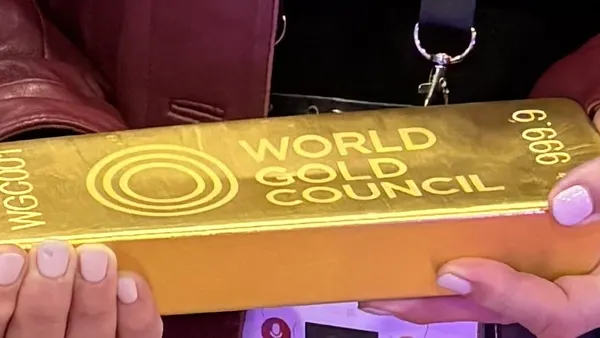
In a sea of companies giving away routine conference swag like notebooks and pens, the World Gold Council booth’s offering shone bright this week.
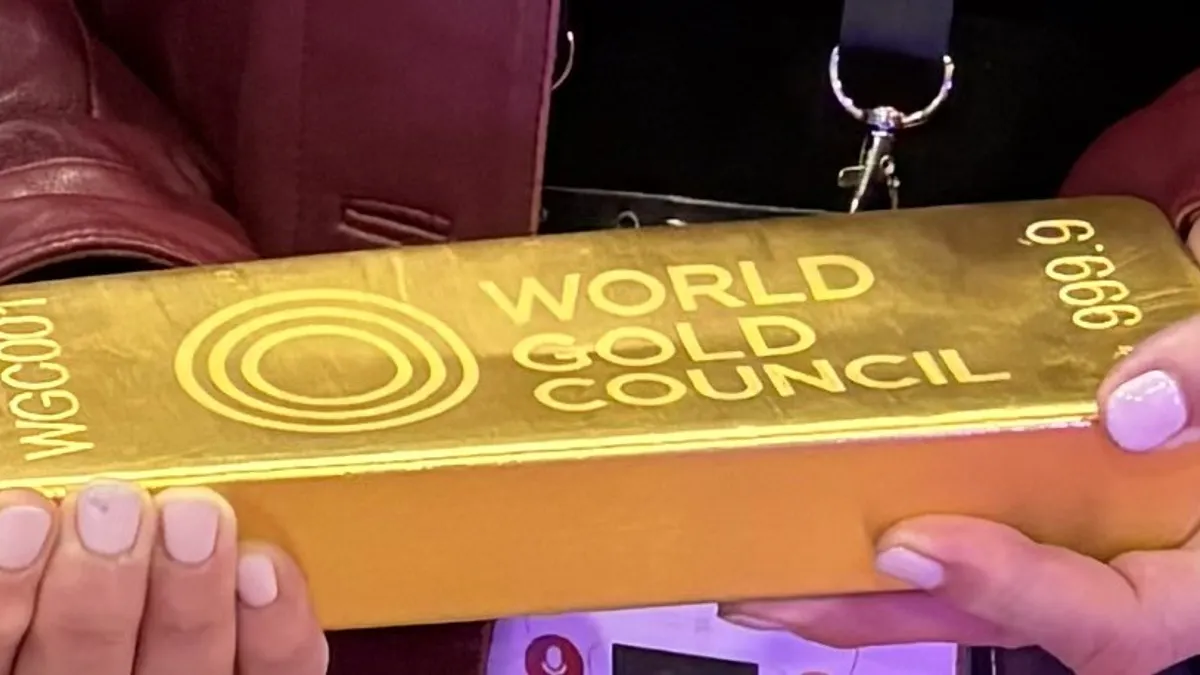
The industry association brought a 400-ounce gold bar — valued at nearly $2 million — to the Money20/20 fintech convention in Las Vegas. To boot, a security officer happily took the block out of a lucite showcase for any visitors interested in getting a closer look.
The dazzling bar’s 25 pounds of weight surprised some who picked it up and the sight of it caused business people to slow down, drop their bags and get in line to hold it.
The move was more than a one-off publicity stunt. It was part of a focused campaign by the association, which represents the world’s biggest gold miners, to increase demand for the iconic mineral while also carving a niche for the asset in the digital world.
“For thousands of years gold has been associated with something physical that you can own and see and touch,” said Stephanie Cadman, WGC’s head of communications in EMEA, during a panel discussion at the conference Wednesday. The challenge is to maintain that trust with digital gold.
In seeking to realize the potential of digital gold, trust is one of the big barriers, Cadman said. Reminding people of physical gold is part of the solution. So too are industry standards, according to a March report co-written by the WGC and the Boston
”Without consistency or standards across backing, custody, audit and redemption terms, consumers cannot assume digital gold products are interchangeable,” the report said. “As a result, consumers must revisit their trust in each individual product, its issuer, and its underlying holdings.”
Digital gold is currently just a tiny fraction of the world gold market, according to an Oct. 19 report from the WGC. Currently, the investment market for physical gold is valued at $13 trillion with digital and tokenized gold making up less than 1% of the market, the report states.
Gold’s appeal goes well beyond jewelry. Its role in economies is partly due to its scarcity and durability, with annual mining supply adding only about 1.8% to the existing above-ground stock, the March report said.
Its “limited and persistent supply, combined with diverse sources of demand, reinforces gold’s role as a long-term store of value,” the reports states.
The role of gold has evolved over the centuries. As far back as 3000 BC, gold took the form of physical coins or bars, in the 1990s gold certificates or book-entry claims emerged and in 2003, exchange-traded funds backed by physical gold got a foothold, according to the report.
Fast forward to 2005 and there were pool allocated digital gold accounts enabling holders to own a fraction of gold and by 2019, people began investing in tokenized gold, some linked to gold of a certain weight held in a vault.
To date, the digital gold market has grown to a value estimated at between $45 and $55 billion, with the October report forecasting that the market could grow to $170 billion by 2031 and, eventually, to $700 billion.
In the increasingly crowded digital and crypto market, gold will have to jockey for a lane. Not only are payment methods like stablecoins growing more mainstream, but both legacy banks and startups are coming to market with new forms of digital currency.
On Monday, JPMorgan announced its blockchain business Kinexys brought JPM Coin, the bank’s USD-denominated deposit token, to Ethereum, the Layer 1 blockchain network. Available to J.P. Morgan’s institutional clients, the move extends the reach of the institution.
A bank spokesperson said JPM Coin isn’t a stablecoin, but as a deposit token, it “serves as a digital representation of a bank deposit on public blockchain.”