Dive Brief:
- Philip Morris International appointed Massimo Andolina, president of its Europe region, to the role of Group CFO effective Aug. 1, according to a Wednesday press release and securities filing.
- Andolina will succeed Emmanuel Babeau, who is leaving after a six-year tenure as the Stamford, Connecticut-based global tobacco company’s CFO. Babeau will remain with the company as a strategic advisor to Group CEO Jacek Olczak through March 31, 2027 to ensure a smooth transition, according to the filing with the Securities and Exchange Commission.
- A long-time insider of PMI, which owns brands including Marlboro and Chesterfield cigarettes as well as its titular Philip Morris tobacco products, Andolina’s “experience, business judgment and leadership will serve him extremely well in his new role as we continue to deliver best-in-class growth and sustainable performance for shareholders,” Olczak said in a statement included in the press release.
Dive Insight:
Andolina has logged a 17-year career with the international tobacco business, joining as its director, global operations of strategy and planning in 2008, according to his LinkedIn profile. He has served in his current role as president of its Europe region since February 2023.
Prior to Philip Morris, he served for seven years in roles at container and packing manufacturing company Tetra Pak, including as its managing director, Tetra Pak Venezuela. His past experience also includes roles at R.J. Reynolds International — now Japan Tobacco International — and Proctor and Gamble.
Andolina’s compensation as CFO has yet to be determined, according to the filing. For the full year 2025, his compensation as president, Europe region totaled approximately $7.8 million, according to the company’s latest proxy statement filed in March.
His predecessor Babeau is entitled to receive post-employment payments and benefits associated with a termination without cause as determined in the company’s 2026 proxy statement, according to the Wednesday SEC filing.
For such a termination under the terms of his employment contract, Babeau is entitled to receive a lump sum cash payment of one time his annual base salary and incentive compensation award — the latter of which would be pro-rated based on his employment period during the year of termination, according to the proxy. His awards of both restricted stock units and performance stock units are also set to vest fully.
For 2025, Babeau received total compensation of about $26.9 million, comprised of an annual base salary of $1.5 million, stock awards of $5.4 million and an increase in the value of his pension to $17.3 million, according to the proxy.
The CFO announcement follows a few weeks after PMI held its annual shareholder meeting on May 6, where company leadership touted continued growth in the business’s smoke-free product segment.
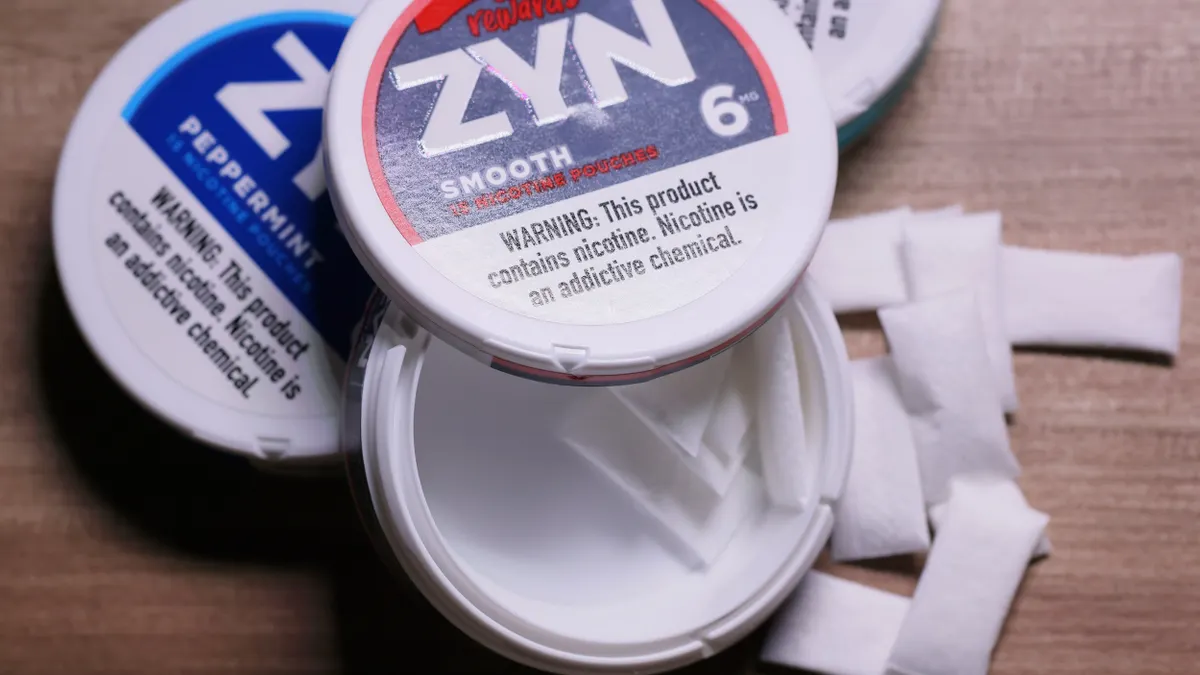
Annual revenues from the company’s smoke-free products — which include heated tobacco and vape products, as well as its ZYN nicotine patches — jumped to $17 billion in 2025, representing 41.5% of total PMI net revenues, according to its investor day presentation.
PMI is one among several tobacco brands that has continued to target growth for its “smoke-free” products as the sub-sector continues to expand, with the U.S. market expected to reach $5.3 billion by 2033, according to a December 2025 Research and Markets report.
Alongside PMI, British American Tobacco and Altria Brands — which owns Philip Morris USA and other brands — are among those that have sharpened their focus on “smoke-free” or “smokeless” products, with BAT reporting that its own range of smokeless products now account for 18% of group revenue, CFO Dive previously reported.
However, smokeless products, including vapes, have also come under tightened regulatory scrutiny in recent years as their usage has expanded. An April report by the European Commission highlighted the emerging public health risks associated with what it termed “novel” tobacco products, such as heated tobacco and nicotine patches, for example. Such products pose a particular risk to young consumers, the report noted.