Dive Brief:
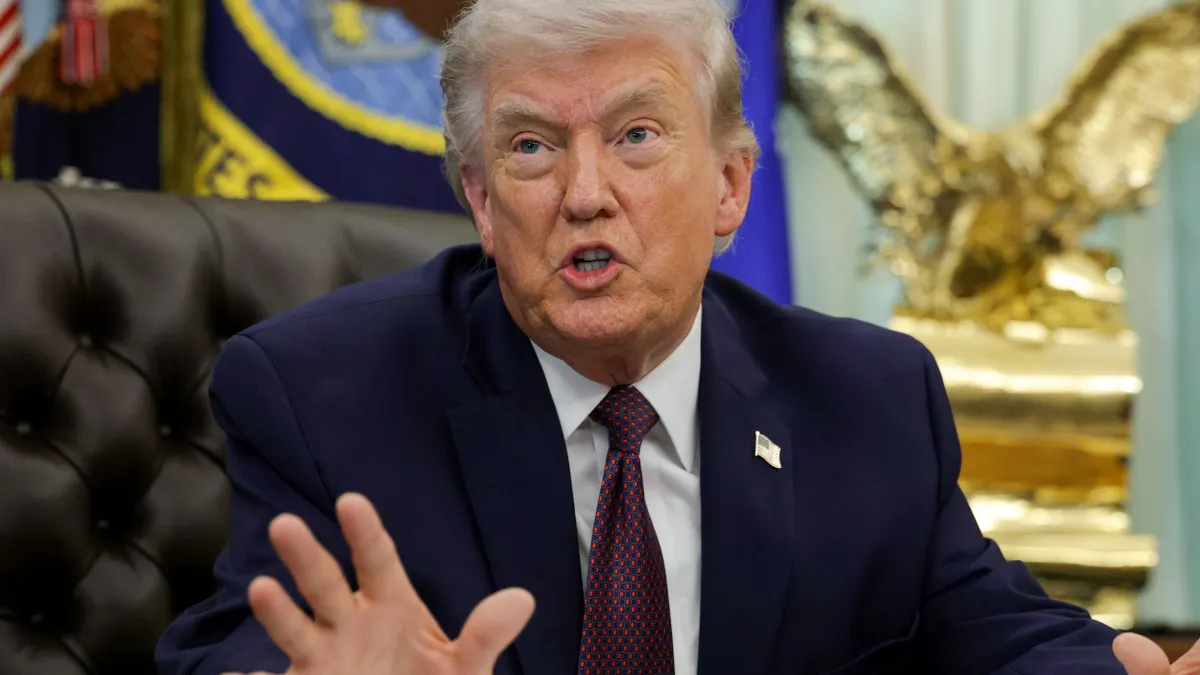
- President Donald Trump on Monday dismissed dire warnings about the potential dangers of artificial intelligence, calling for the U.S. to prioritize staying ahead of China over imposing new limits on the technology.
- In a post on Truth Social, Trump said AI will be the “greatest economic development engine in history,” and he indicated that any efforts to slow its growth in the U.S. will not succeed during his presidency.
- “AI taking over the World, destroying Humanity, and all other things bad, is a HOAX,” the president said.
Dive Insight:
Trump’s comments add uncertainty to the outlook for new federal safeguards as AI industry leaders and some lawmakers push for stronger oversight of increasingly capable systems.
In a September essay, Anthropic CEO Dario Amodei called for slowing the pace of AI development so safety efforts have time to keep up with rapidly advancing capabilities. He proposed independent third-party evaluators with employee-like access to AI companies, along with coordination among companies and governments on safety standards and limits on the pace of development.
OpenAI CEO Sam Altman backed Amodei’s call in a post on X and said his company would adopt the independent evaluator approach.
Vice President JD Vance expressed skepticism about the industry’s calls for regulation Monday during remarks to reporters in Kansas, saying the administration is concerned about AI risks but wants any rules to be developed carefully. Vance said he finds it unusual that leading AI companies are asking the government to regulate them and called the push “a little bit of a Trojan horse.”
Lawmakers are divided over how quickly Congress should move to address AI safety concerns.
House Speaker Mike Johnson, R-La., rejected the idea of an emergency moratorium on AI development during a CNN interview Sunday, warning that moving too quickly on regulation could hamper U.S. innovation efforts and cede ground to China.
Johnson proposed bringing AI companies and government officials together to develop guardrails that balance safety with continued innovation. He said lawmakers need to work with the industry because Congress does not have the same technical expertise as frontier AI companies.
“If Congress just races in and does some sort of emergency session to try to regulate AI, we will lose the race to China, and that is a threat to every single American,” Johnson said during the CNN interview. He said executives are free to take voluntary steps to address AI risks in the meantime.
House Minority Leader Hakeem Jeffries, D-N.Y., struck a more urgent tone Monday at a news conference, saying the risks associated with AI are real and require Congress to act immediately. Jeffries noted that leading AI voices have called for slowing development to protect health, safety and well-being.
Recent incidents involving AI systems along with increased warnings from AI safety researchers, have dramatically increased attention on the issue, boosting the chances for legislative action, according to Adam Conner, vice president for technology policy at the Center for American Progress, a think tank.
“Congressional action in the near time, if it happens at all, is likely to be focused on the narrower but time-sensitive issues of federal standards and safeguards for frontier AI models — the most cutting-edge models that have the greatest risks of catastrophic harms,” he said in an email.
He predicted the next Congress “will almost certainly take on broader AI questions including potential job loss, data centers and other critical issues.”
Darrell West, a senior fellow in governance studies at the Brookings Institution, said the outlook for federal AI legislation — particularly in the short term — is “not good” in light of divisions over the need for safety standards and what kinds of rules would be helpful.
“In the absence of federal laws, the states are moving ahead,” West said in an email. “Many states have one-party control so polarization is not going to stop legislation the way it does at the national level. Companies may end up with a patchwork of laws that differ significantly, which poses problems for their operations.”