Dive Brief:
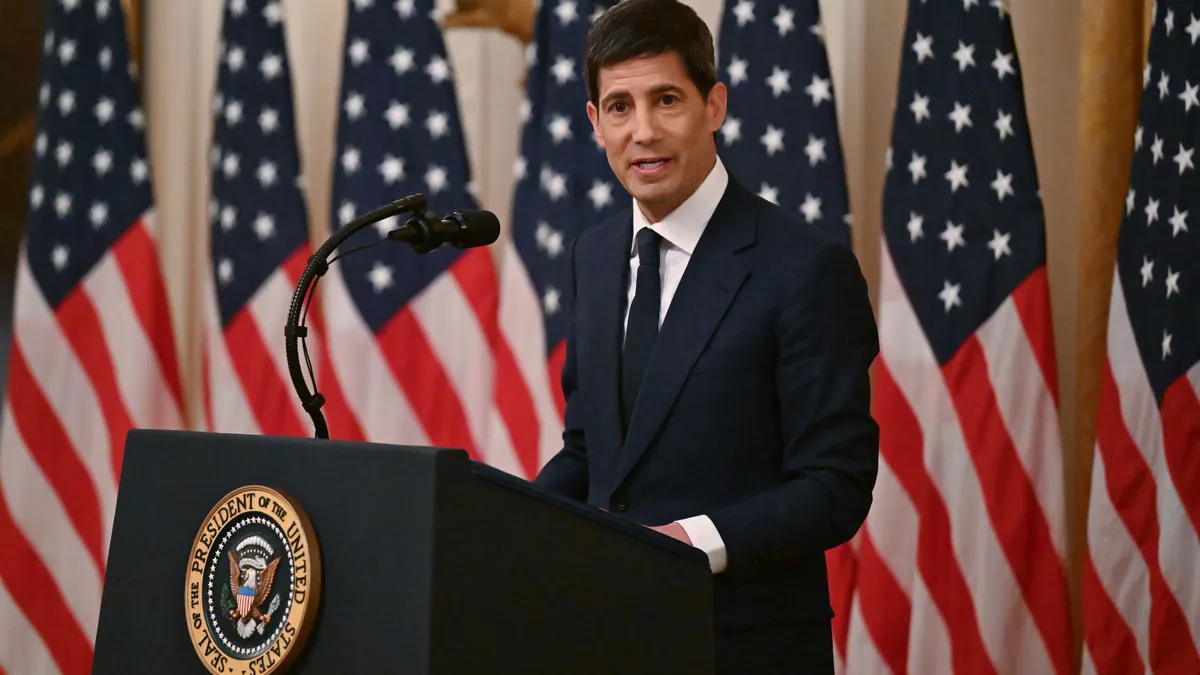
- The U.S., while leading in artificial intelligence, is competing with China for AI dominance and U.S. banks need to be aware of how the emerging technology may be used against them, Federal Reserve Chair Kevin Warsh said in testimony before a Senate committee.
- “They’re a pacing power” to the U.S., Warsh told the Senate Banking Committee, referring to China. “The fight over AI is one of a proxy fight between these two economies that are striving for significance and influence over the next decade,” he said.
- “We are on the front end of those technologies, but I don’t want to sound complacent about it,” Warsh said, noting that “like with all technologies, they can be used by friends or adversaries.”
Dive Insight:
Warsh, testifying to the Senate panel for the first time as leader of the Fed, said the central bank needs to underscore to U.S. banks the threat posed by an adversary deploying AI.
“If there’s a subject upon which I’ve focused related to this in my first seven weeks, it’s making sure the institutions we regulate and the Fed itself is aware of our vulnerabilities” to attacks using AI, he said. “I still think we’ve got some work to do on that.”
Warsh since 2022 has publicly warned U.S. policymakers of the economic threat from China.
In a November 2022 op-ed in The Wall Street Journal, Warsh said the creation by China of a digital form of its currency “threatens the dominance of the U.S. dollar and American hegemony.”
The e-CNY, the digital currency launched by China’s central bank in April 2020, “is a significant technological breakthrough that poses promise and peril for the American-led global financial system,” he said.
“In the hands of a powerful sovereign such as China, the new software is an effective way to launch the yuan into the big leagues,” said Warsh, a Fed governor from 2006 to 2011, who wrote the op-ed while serving as a visiting fellow in economics at the Hoover Institution.
Warsh called on policymakers to “respond with a strengthened form of the dollar in service to the national interest.”
In order to safeguard its No. 1 status of its currency worldwide, the U.S. should create a digital dollar to be used exclusively for wholesale transactions, Warsh said, “noting that the existing wholesale payment system is slow, cumbersome, opaque and expensive.”
Warsh told the Senate committee on Tuesday that AI poses profound benefits and risks to the U.S.
“I can't think, Mr. Chairman, of a more consequential change to the U.S. and global economy in my life — in my adult lifetime — than the surge of investment and the potential in around AI,” he said.
Warsh noted that after assuming the leadership role at the central bank seven weeks ago, he announced the creation of a “task force” to focus on the impact of AI on Fed efforts, as mandated by Congress, to ensure stable prices and full employment.
“I would say it is a huge opportunity, but it's not without challenges,” Warsh said, referring to AI.
“I think the United States is extremely well positioned to be at the cutting edge and extract more productivity, which should be good for U.S. companies and U.S. workers than any other country in the world,” he said. “Any other country would exchange positions with us in a moment.”