Dive Brief:
- Nvidia interim CEO Colette Kress sought to reassure investors during her first earnings call in the chipmaker’s top seat, saying customers, suppliers and business partners remain supportive of the company after the upheaval driven by CEO Jensen Huang’s departure.
- “We've engaged with our customers, we've engaged with our suppliers, our partners. They're all 100% up behind us,” Kress said during the company's earnings call for its fiscal 2027 third quarter.
- The company posted third-quarter revenue of $115.8 billion, up 103% from a year earlier and 20% from the previous quarter. Data center revenue, driven by demand for artificial intelligence infrastructure, rose 110% to $107.6 billion.
Dive Insight:
Kress, who has served as Nvidia's CFO since 2013, was named interim CEO after Huang resigned from his role last week, while also continuing to serve as its finance chief.
Tuesday’s earnings call marked her first in the new role, and she sought to reassure investors that the leadership transition would not disrupt Nvidia’s operations or derail its momentum.
“We have the best technologists on the planet, with a world-class, multiyear roadmap,” Kress said Tuesday. “From this perspective, it's business as usual.”
Nvidia on Tuesday also raised its fiscal 2028 revenue growth projection to about 75% from 70%. Kress said the higher forecast reflects both continued growth in demand and additional supply the company expects to provide.
Kress walked investors through Nvidia’s latest results after Huang’s abrupt exit at the company left a major leadership gap at one of the world’s most-watched AI companies.
Huang, Nvidia’s long-time CEO and founder, has been closely associated with its technology strategy, product roadmap and relationships across the AI industry, before he resigned following reports that he had a relationship with a woman suspected by U.S. authorities of having ties to Chinese intelligence.
Board chair Harvey C. Jones said during Tuesday’s call that the board unanimously accepted Huang's resignation after disclosure of “personal behavior inconsistent with the company's code of conduct, standards, and cultural norms.” He said the board does not intend to reinstate Huang as CEO.
The board has retained executive search firm Heidrick & Struggles to lead the search for a permanent CEO, Jones said. It is considering both internal and external candidates.
“We want to install the CEO, the permanent CEO, as quickly as possible, but we won't expedite the CEO before finding exactly the right person,” Jones said.
He said the next CEO will need to navigate changes in advanced silicon technologies and national security dynamics affecting Nvidia's market. The board has not announced a timetable for the appointment.
Kress’ appointment as interim has led to speculation and questions about who will steer Nvidia forward as Nvidia considers permanent candidates for Huang’s successor.
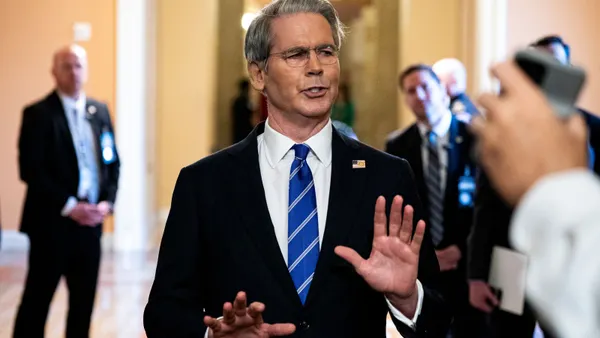
U.S. Treasury Secretary Scott Bessent on Sunday called for Nvidia's board to pursue a “dramatic shake-up” and urged it to look outside the company for Huang's successor. Bessent questioned whether potentially illicit chip sales to China had been used to boost Nvidia's earnings.
Morningstar recently lowered its fair value estimate for Nvidia to $250 from $310 per share amid uncertainty over the leadership transition. After Nvidia released its earnings report Tuesday, Brian Colello, a senior equity analyst at Morningstar, said its Q3 results should help ease some concerns about the upheaval.
“Shipments have not slipped, and we remain confident that the AI infrastructure buildout is real,” Colello said. He added that a credible succession plan could help steady investor sentiment, while noting that Huang's successor will face significant expectations.
Brian Mulberry, chief market strategist at Zacks Investment Management, suggested that Kress made a strong impression in her first earnings call as interim CEO.
“The interim CEO was calm and confident in laying out the facts showing that growth is largely intact and the company is still executing financially,” Mulberry said.
But Mulberry cautioned that Nvidia's management team faces regulatory and political challenges. The Wall Street Journal reported Tuesday that the Securities and Exchange Commission is investigating Nvidia. The company could also face congressional scrutiny, Mulberry noted.
“There are several investigations to get through, including a new SEC inquiry around misleading shareholders after they stopped reporting country specific revenues and pulled back to larger regional reporting,” he said. “This could be seen as obfuscating data on sales that may end up in China, but the inquiry needs to play out before we will know.”
Nvidia did not immediately respond to a request for comment.