Dive Brief:
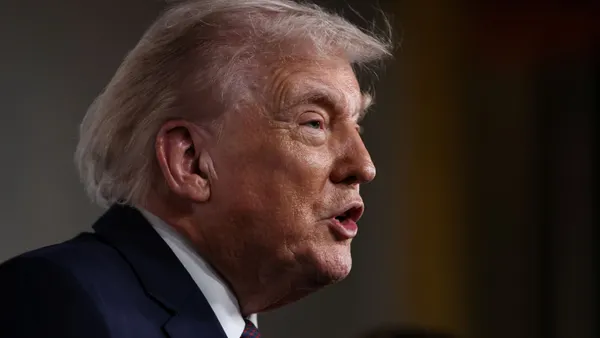
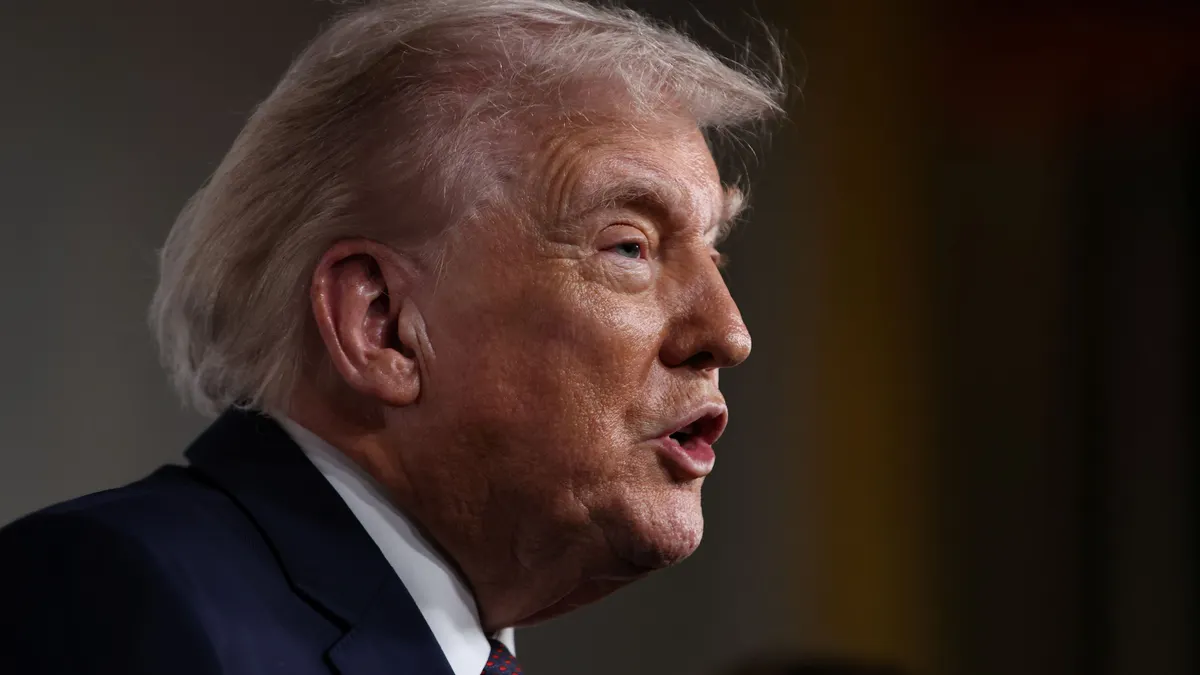
- President Donald Trump said in an interview broadcast Sunday that he would consider working with Democrats on artificial intelligence safeguards but warned that regulation should not slow U.S. development of the technology.
- “I don’t mind guardrails,” Trump said in an interview on CBS’ “60 Minutes.” But he added that he did not want the U.S. put in “a deep second position” in AI development behind China, which he said has no comparable restrictions.
- Trump also downplayed concerns that AI could pose an existential threat, saying the risks are “not nearly as real as” some suggest and can be managed.
Dive Insight:
The comments offer some indication of how Trump may approach AI policy after Democrats won control of both chambers of Congress in the midterm elections, results some commentators have described as a “blue tsunami.” But the president did not identify specific safeguards he would support or outline a regulatory framework.
Trump previously took a harder line against AI safeguards. In a Sept. 15 Truth Social post, he dismissed warnings about AI's potential dangers as a “hoax” and indicated that efforts to slow the technology’s development in the U.S. would not succeed during his presidency.
The push for tighter AI regulation gained high visibility during midterm campaigns, with candidates in some races addressing concerns about data-center construction, rising electricity costs and the technology’s potential effects on jobs. Multiple surveys also found broad public support for greater government oversight of the technology.
Post-election regulatory uncertainty has already begun to weigh on tech-related stocks. “Overall, AI stocks like Nvidia sold off last week, largely attributed to Democrats winning both chambers of the US Congress and raising the risk of increased AI regulation,” Morningstar analyst Brian Colello wrote in a Nov. 9 research note.
Trump’s shift in tone on AI also comes amid reports of a relationship between Nvidia CEO Jensen Huang and a Chinese business executive suspected by U.S. intelligence of gathering information for Beijing. Huang has informed Nvidia employees that he had an extramarital affair and apologized to his colleagues. Nvidia's board of directors has announced an independent investigation into the matter.
Trump defended Huang on Sunday, calling him “an honorable guy” who had “done an amazing job for our country,” according to Reuters.
Colello said the developments could lead to Huang’s ouster. “We’ve long considered Nvidia and Jensen Huang to be at the center of the AI ecosystem; his departure could lead to less AI dealmaking and financing, greater regulation, and more political backlash around artificial intelligence,” he said.
Colello said investigations and espionage now add “to the uncertainty around Nvidia’s valuation amid the rapidly evolving AI buildout.”